
IMS Bearing Problem Years

IMS Bearing Problem Years
Know IMS Bearing Problem Years: it is crucial to understand that the IMS bearing plays a vital role in Porsche Boxster and Porsche 911 996 models. It is essential to be aware of the problematic years. By replacing the intermediate shaft bearing as part of regularly scheduled maintenance, expensive engine repairs or replacement can be avoided.
Avoiding IMS Bearing Issues in Porsche Boxster and Porsche 911 996 Models: Know the Problem Years
In this blog we’re covering:
- Porsche 911 IMS Bearing Problem Years
- Porsche Boxster IMS Bearing Problem Years
- Which Porsche IMS bearings are the most problematic?
- What can be done to avoid failures in IMS bearing problem years?
- In what year did Porsche fix the IMS bearing problem?
- When does the IMS bearing need to be replaced?
Porsche IMS Bearing Problem Years

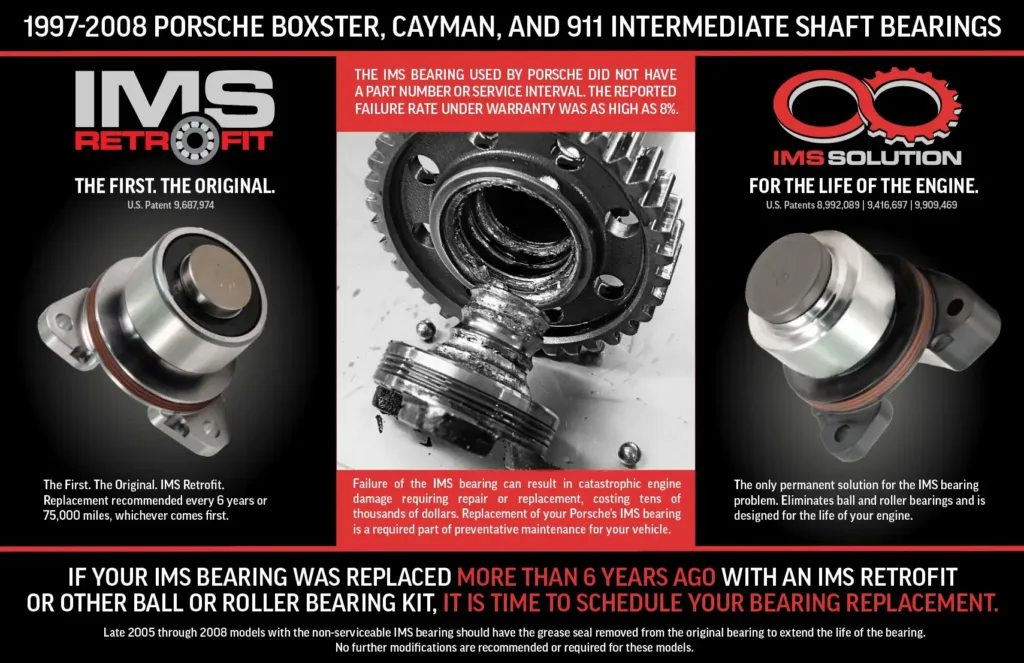
If you own a Porsche Boxster or Porsche 911 996 model, you may be familiar with the notorious IMS bearing issue. The IMS (intermediate shaft) bearing is a small but crucial component in the engine of these cars. Unfortunately, certain years of these models are more prone to IMS bearing failures. Failure rates have reached as high as eight percent under warranty as highlighted by the Eisen Class Action lawsuit filed against Porsche. Outside of warranty, failure rates are believed to be significantly higher.
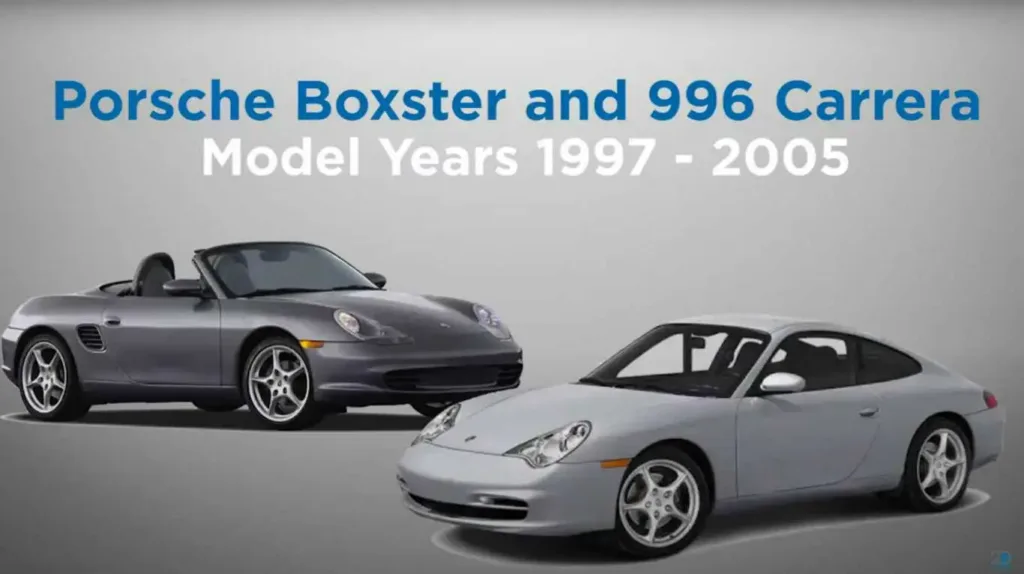
The Porsche IMS bearing problem years are from 1997 to 2005, with the M96 or M97 engine in these models being particularly susceptible. The single-row bearing used from model year 2000 through 2005 is of the greatest concern. However, any IMS bearing can and will fail if not replaced as part of regular maintenance.
A failed IMS bearing can lead to catastrophic engine damage and costly repairs, making it essential to be aware of the issue and take necessary precautions. To avoid IMS bearing issues, it’s recommended to have the IMS bearing replaced with an upgraded bearing like the IMS Retrofit kit or IMS Solution. The IMS Solution is the only permanent fix for the IMS bearing problem. Doing so can prevent expensive engine damage and extend the life of your engine.
It is crucial to know the problem years and take necessary steps to prevent IMS bearing failures. Be proactive and protect your investment by replacing your IMS bearing with an upgraded solution. Don’t wait until it’s too late – keep your car running smoothly and avoid costly engine repairs. Remember, prevention is always better than cure!
One simple thing you can do to extend the life of your engine as a whole is to change your oil more often. Also, be sure to use Driven DT40 rather than a Porsche A40 approved oil. Not only will your IMS bearing thank you, but you’ll also help protect against cylinder bore scoring.
Porsche 911 Model Years
Depending what model year, Porsche used different IMS bearings, with some years being more problematic than others:
- 1999 Porsche 911 996.1 – Dual Row IMS Bearing
- 2000-2001 Porsche 911 996.1 – Dual Row or Single Row IMS Bearing
- 2002-2005 Porsche 911 996.2 – Single Row IMS Bearing (some late 2005 builds may have the larger, non-serviceable IMS bearing)
- 2006-2008 Porsche 911 997.1 – Larger, Non-Serviceable Single Row IMS Bearing
The most problematic years are 2000 through 2005 where the factory single row bearing was used. The single-row IMS bearing used had high failure rates of up to 10% under warranty, while the dual-row bearing had a lower rate. However, failure rates outside of warranty are suspected to be even higher.
When the IMS bearing fails, it results in a loss of camshaft timing that can cause severe damage to the engine, including bent valves and debris. Replacing the intermediate shaft and addressing any collateral damage requires a complete engine disassembly. Therefore, all IMS bearings must be changed as part of preventative maintenance, similar to a timing belt in modern engines.
Cars that sit idle, are driven infrequently, or travel short distances are most susceptible to failure. In newer Porsche 911 models with larger, non-serviceable 06-08 IMS bearing, the grease seal should be removed to extend the life of the original bearing as replacing the bearing requires complete engine disassembly which is costly and impractical.
Porsche Boxster Model Years
Like with the Porsche 911, the Boxster IMS bearing problem years vary from year to year depending on which IMS bearing was used by Porsche:
- 1997-1999 Porsche Boxster 986 – Dual Row IMS Bearing
- 2000-2001 Porsche Boxster 986 – Dual Row or Single Row IMS Bearing
- 2002-2005 Porsche Boxster 987 – Single Row IMS Bearing (some late 2005 builds may have the larger, non-serviceable IMS bearing)
- 2006-2008 Porsche Boxster 987 – Larger, Non-Serviceable Single Row IMS Bearing
For the Boxster, the IMS bearing problem years where a failure of the original intermediate shaft bearing is most likely are model years 2000 through 2005. However like with the 911, all models with a serviceable IMS bearing should have the bearing replaced to prevent catastrophic ims bearing failures. Like with the Porsche 911, Boxster models with the larger, non-serviceable single row IMS bearing should also have the grease seal removed. All Porsche Cayman models from 2006 through 2008 will also have the larger, non-serviceable single row IMS bearing.
What can be done to avoid IMS failures in cars affected by IMS issues?
As mentioned above, all Porsche Boxster and 911 models from 1997 through 2005 can be affected by IMS bearing issues. However, vehicles from 2000 through 2005 fitted with the serviceable single row IMS bearing is the most prone to failure. Therefore, any vehicle still fitted with the original bearing should have the IMS bearing replaced immediately. Unlike the earlier dual row bearing, which generate ferrous debris that looks like glitter well before the bearing fails completely, the single row bearing does not give any warning prior to failure. That is why it is so important to chance this bearing out. Remember, once the IMS bearing fails, replacement is no longer an option.
Not sure about the overall health of your Porsche engine? Used oil analysis should be part of your maintenance routine.

Learn more about How to Identify and Fix the Porsche IMS Bearing Problem and How to Determine When and if your Porsche IMS Bearing Needs to be Replaced.
Replacement options include the IMS Retrofit and IMS Solution, the latter replacing the problematic ball bearing with an oil pressure fed plain bearing which is the only permanent solution. All other ball or roller bearing replacements, including the IMS Retrofit, have service intervals and require future replacement based on time and/or mileage requirements. Learn more about When Replace the Porsche IMS Bearing.
On engines where the IMS bearing is not serviceable, the grease seal should be removed to allow the engine oil to properly lubricate the original IMS bearing. This includes all Porsche Boxster, Cayman, and 911 models from 2006 to 2008 and all replacement engines manufactured by Porsche in or after model year 2006. Learn more about the non-serviceable 06-08 Porsche IMS bearing.
In What Year Did Porsche Fix the IMS Bearing Problem?
Porsche’s first attempt to address the Porsche IMS bearing issue brought about the change to the larger, non-serviceable intermediate shaft bearing. Porsche chose a 6305 single row ball bearing which provided similar load capacity to the original dual row bearing, however the larger diameter provided increased bearing speeds which are beneficial to the longevity of the bearing.
The drawback to this is that the diameter of the bearing is larger than the hole in the case, so the bearing cannot be removed without complete engine disassembly. Porsche also chose to retain a grease seal like previous IMS bearings which prevents the engine oil from properly lubricating and cooling the bearing, which is submerged in engine oil during normal operation.
Although significantly better than ims bearing used in model year 2000 through 2005 Porsche Boxster and 911 engines, the IMS bearing is still a problem with the 2006 through 2008 model years.
Beginning with the 2009 model year, Porsche redesigned the engine for the Boxster, Cayman, and 911 to eliminate the IMS shaft completely. The camshafts are now directly driven off the crankshaft in the MA1 (9A1) engine.
It is worth noting that the aircooled Porsche Mezger engine which was later adapted for use in the Porsche 911 GT3, Turbo, and GT2 successfully retained its intermediate shaft through the end of production. This design utilized oil pressure fed plain bearings.
Avoid a $40,000 Mistake: Know Your Odds
If your Porsche falls within the 2000–2005 range, you’re at a higher risk. Don’t leave it to chance—take preventive action now.
- 8% failure rate for single-row IMS bearings in 2000–2005 models under warranty
- Failure rates only increase as vehicles age
- No factory IMS bearing is immune to failure
Proactive IMS bearing replacement costs a fraction of an engine rebuild. Protect your Porsche and your wallet—schedule your IMS upgrade today. Drive with confidence your Porsche engine is protected.
What Porsche model years have IMS bearing problems?
Porsche models produced from 1997 to 2008 are affected, including Boxster, Cayman, and 911 models with M96 and M97 engines. The severity and type of IMS bearing varies by model year and engine revision. The single row bearing used from 2000 through 2005 is the most failure prone, with an 8% failure rate under warranty and even higher out of warranty.
What is the Porsche IMS bearing problem?
The IMS (Intermediate Shaft) bearing can fail due to age, poor lubrication, insufficient load capacity, and lack of factory service intervals, leading to catastrophic engine failure. This issue primarily affects M96 and early M97 Porsche engines with the single row bearing, but can also affect the early dual row and later non-serviceable IMS bearing.
How do I know if my Porsche has an IMS bearing issue?
If your car was built between 1997 and 2008, it may be at risk. You can identify your IMS bearing type based on your model year, VIN, or by performing a physical inspection. Symptoms of a failing IMS bearing include metal in the oil, oil leaks, engine noise, and loss of camshaft timing.
hich IMS bearing type does my Porsche have?
Porsches with M96 engines from 1997 to 1999 typically use a dual row bearing. Models from 2000 to 2001 can have either a dual or single row. 2002 to early 2005 use a single row bearing. In late 2005 models and all 2006 to 2008, a larger non-serviceable bearing is used, which still has known failure potential, so removing the grease seal is recommended to extend bearing life.
What is the failure rate of Porsche IMS bearings?
Failure rates vary: dual row bearings have an estimated failure rate of less than 1% while they were under warranty, while single row bearings have failure rates at 8%, which only increases as these cars get older. Although they seldomly do fail, even the larger factory bearings used from 2006-2008 are not immune to failure.
Can I prevent IMS bearing failure?
Yes. Preventative replacement with an upgraded IMS Retrofit or IMS Solution can eliminate the risk of failure. Performing regular oil analysis and using high-quality lubricants also help monitor the engine’s health.
What is the difference between IMS Retrofit and IMS Solution?
The IMS Retrofit is a serviceable ceramic hybrid ball bearing replacement (a cylindrical roller version is also available), while the IMS Solution is a permanent oil pressure fed plain bearing that eliminates the original bearing design entirely. The IMS Solution is the only permanent fix and is suitable for long-term peace of mind.
When should I replace my Porsche’s IMS bearing?
It is recommended to replace the IMS bearing preemptively during clutch service or at intervals of every 6 years or 75,000 miles, whichever comes first, unless fitted with an IMS Solution. Vehicles with unknown service history should be inspected immediately.
What happens if my IMS bearing fails?
If the IMS bearing fails, it can result in loss of camshaft timing, valve-to-piston contact, and catastrophic engine damage. The cost of repair may exceed $30-40k depending on the extent of the damage.
Is the IMS bearing issue covered by a recall?
No, Although it was subject to the Eisen Class action settlement, for most owners IMS bearing issues were not covered. It is considered a known issue and many independent shops offer retrofit and solution kits to proactively address it.