
Identifying & Fixing the Porsche IMS Bearing Problem

Porsche IMS Bearing Problems: How to Identify & Fix Them
How to Identify and Fix the Porsche IMS Bearing Problem
Porsche IMS bearing problems primarily affect 1997–2008 Boxster, Cayman, and normally aspirated 911 models equipped with M96 and M97 engines. The most failure-prone factory design is the smaller single-row bearing used in many 2000–2005 engines, which had an approximately 8% reported failure rate during the warranty period. Earlier dual-row bearings and the larger 2006–2008 non-serviceable bearing had substantially lower reported failure rates of approximately 1%.
Identifying an IMS bearing problem is not always straightforward. The later single-row bearing can provide little or no warning before failure, while the earlier dual-row bearing may begin producing visible ferrous debris in the oil filter before complete failure. For that reason, diagnosis should consider the bearing design, service history, oil-filter inspection, engine condition, and whether the engine is still a suitable candidate for preventative IMS service.
In This Guide
- What the Porsche IMS bearing does and why it can fail
- What causes Porsche IMS bearing failure
- Symptoms and warning signs of IMS bearing failure
- How to diagnose a Porsche IMS bearing problem
- How to fix the Porsche IMS bearing problem
What Is the Porsche IMS Bearing and Why Does It Fail?
IMS stands for intermediate shaft. Porsche has used an intermediate shaft for decades to drive the camshafts indirectly from the crankshaft. In the aircooled 911 and later water-cooled Mezger-derived Turbo, GT2, and GT3 engines, the intermediate shaft is supported by pressure-fed plain bearings.
With the introduction of the Boxster in 1997 and the 911 996 in 1999, Porsche changed the flywheel-side support of the intermediate shaft to a sealed ball bearing in the M96 and later M97 engines. The ball bearing provides both radial and axial support, but Porsche did not specify a service interval or originally provide a procedure for replacing it separately from the intermediate shaft.
The factory bearing design changed over time. Earlier engines generally used a stronger dual-row bearing. Porsche began phasing in a smaller single-row bearing around model year 2000, and this design became the most failure-prone factory IMS bearing. For model years 2006–2008, Porsche adopted a larger non-serviceable bearing that is more robust but cannot normally be replaced without complete engine disassembly.
Because 2005 was a transition year and factory replacement engines may use a different IMS bearing than the vehicle originally received, model year alone cannot identify every bearing configuration. For a detailed year-by-year breakdown, see our Porsche IMS Bearing Problem Years guide.
Not Sure Which IMS Bearing Your Porsche Has?
Model year alone cannot identify every 2000–2001 or 2005 engine, and a factory replacement engine may have a different IMS bearing than the vehicle originally received. Use the IMS Lookup or verify the bearing configuration before planning service.
What Causes Porsche IMS Bearing Failure?
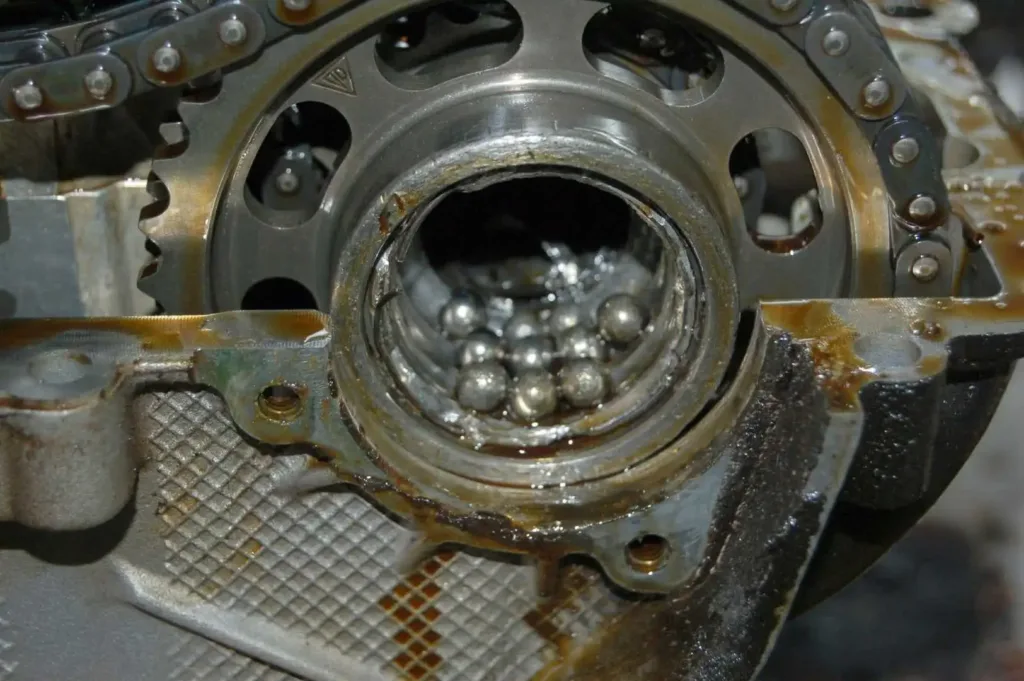
IMS bearing failure is usually the result of multiple contributing factors rather than one single cause. Factors that can influence bearing life include:
- Insufficient load capacity
- Poor lubrication
- Extended oil drain intervals
- Manufacturing quality issues
- Elevated engine temperatures
- No factory scheduled replacement interval
The smaller single-row IMS bearing used in many 2000–2005 engines had an approximately 8% reported failure rate during the warranty period. The earlier dual-row bearing and larger 2006–2008 bearing had substantially lower reported failure rates of approximately 1%. These figures should not be treated as lifetime failure rates, and no factory sealed IMS bearing should be assumed immune simply because it has survived to date.
Insufficient load capacity is an important factor in the higher failure rate of the smaller single-row bearing, but lubrication, contamination, oil condition, operating temperature, bearing age, and vehicle usage can also affect service life. IMS failures have historically been associated with vehicles that are driven infrequently, sit for extended periods, or are used primarily for short trips, but there is no single operating pattern that guarantees or prevents failure.
What Are the Symptoms of Porsche IMS Bearing Failure?
- Ferrous metal debris in the oil filter
- Abnormal mechanical noise
- Increasing camshaft deviation or timing faults
- Loss of camshaft timing in advanced failure
- In some single-row failures, little or no useful warning before failure
An IMS bearing can fail with little warning, especially the smaller single-row design. When warning signs are present, they can include ferrous metal debris in the oil filter, abnormal mechanical noise, or changes in camshaft timing as the failure becomes more advanced. Once the bearing loses enough integrity to affect cam timing, severe internal engine damage can occur.
The absence of visible debris does not prove that the IMS bearing is healthy. The single-row bearing can progress from apparently normal operation to failure with little or no visible warning. The earlier dual-row bearing is more likely to generate ferrous debris over a longer period before complete failure, but continued operation after debris appears can circulate wear material throughout the engine.
Because IMS wear debris is typically larger than the particle size measured by standard ICP or RDE oil analysis, conventional used oil analysis alone is not a reliable way to identify a failing IMS bearing. A separate particle-count and particle-size analysis is required to evaluate larger debris. Oil-filter inspection therefore remains important, but neither a clean filter nor a normal standard oil analysis should be interpreted as proof that the bearing is safe.
How Do You Diagnose a Porsche IMS Bearing Problem?
There is no single test that can guarantee the condition of an original IMS bearing. Diagnosis should combine the known bearing type and service history with inspection of the oil filter and sump, evaluation of camshaft deviation, and a broader assessment of engine health. If the vehicle is being considered for an IMS Retrofit or IMS Solution, the engine should be prequalified before the bearing is replaced.
A proper IMS prequalification can include sump and oil-filter inspection, camshaft deviation, cylinder inspection, fuel trims, over-rev data, crankcase vacuum, and checks of related systems such as the injectors, MAF, and oxygen sensors. Any significant evidence of internal engine problems or an IMS bearing that has already begun to fail should be addressed before preventative IMS service is performed.
Learn more about the IMS Retrofit and IMS Solution prequalification procedure.
How Do You Fix the Porsche IMS Bearing Problem?
For 1997–2005 engines with a serviceable factory IMS bearing, the preferred approach is preventative replacement before the original bearing begins to fail. LN Engineering offers several replacement strategies, including the Classic Dual Row and patented Single Row Pro IMS Retrofit, which use open ceramic-hybrid ball bearings lubricated by engine oil.
For owners who prefer a cylindrical roller design, the RND RS Roller IMS Retrofit uses a purpose-selected roller bearing with internal fore-and-aft thrust control. This option exists because of customer preference and market demand, not because the ceramic-hybrid ball-bearing IMS Retrofit is inferior.
The IMS Solution takes a different approach by eliminating the rolling-element bearing altogether and converting the IMS to an oil-pressure-fed plain bearing. Because there are no balls, races, or cages, the IMS Solution has no scheduled IMS replacement interval and is the permanent solution for applicable engines.
For 2006–2008 engines with the larger non-serviceable IMS bearing, replacement is not normally practical without complete engine disassembly. When the transmission is removed for clutch or rear-main-seal service, LN Engineering recommends removing the factory grease seal so engine oil can better lubricate and cool the original bearing. Learn more about the larger non-serviceable 2006–2008 IMS bearing.
Not sure which approach applies to your Porsche? Start by identifying the bearing in the engine, reviewing its service history, and confirming that the engine is healthy enough for preventative IMS service. For a year-by-year breakdown, see our Porsche IMS Bearing Problem Years guide. For replacement timing and service intervals, see When to Replace the Porsche IMS Bearing.
Need help choosing the correct IMS approach for your Porsche? Review the products below or contact LN Engineering for application guidance.
| Image | SKU | Name | Price | Buy: | Stock | hf:tax:product_cat | hf:tax:vehicle-fitment |
|---|