
IMS Bearing Problem Years

Porsche IMS Bearing Problem Years: Boxster, Cayman, 996 & 997
Which Porsche Years Have IMS Bearing Problems?
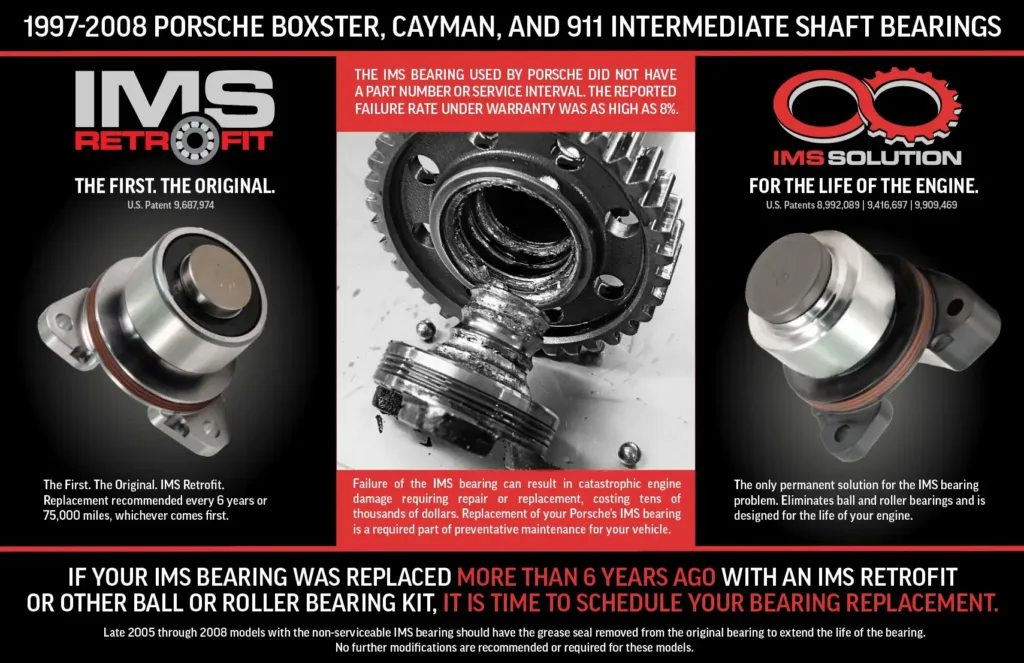
Porsche IMS bearing problems primarily affect 1997–2008 Porsche Boxster, Cayman, and 911 models equipped with M96 and M97 engines. The highest-risk years are 2000–2005, when Porsche used the smaller single-row IMS bearing that was reported to have an approximately 8% failure rate during the warranty period. Earlier 1997–1999 engines generally used the stronger dual-row bearing, while 2006–2008 engines use a larger, non-serviceable IMS bearing. Beginning with the 2009 model year, Porsche’s MA1 (9A1) engine eliminated the intermediate shaft and IMS bearing entirely.
In This Guide, We Cover:
- Porsche IMS bearing problem years at a glance
- Porsche 911 996 and 997 IMS bearing problem years
- Porsche Boxster 986 and 987 IMS bearing problem years
- Porsche Cayman 987 IMS bearing problem years
- Why 2005 is a complicated IMS bearing year
- Whether you should buy a Porsche from an IMS problem year
- How to reduce the risk of IMS bearing failure
- What changed with the IMS bearing for 2006–2008
- When Porsche eliminated the IMS bearing
- Whether 996 and 997 Turbo, GT2, and GT3 models have IMS bearing problems
- Understanding the cost and risk of IMS bearing failure
- Porsche IMS bearing FAQ
Porsche IMS Bearing Problem Years at a Glance
| Model Years | Models | Factory IMS Bearing | Relative Concern | What Owners Should Know |
|---|---|---|---|---|
| 1997–1999 | Boxster 986 | Dual-row | Lower, but not zero | Serviceable; preventative replacement recommended |
| 1999 | 911 996 | Dual-row | Lower, but not zero | Serviceable; preventative replacement recommended |
| 2000–2001 | Boxster 986 / 911 996 | Dual-row or single-row | Varies | Bearing type cannot reliably be determined by model year alone |
| 2002–2004 | Boxster 986 / 911 996 | Single-row | Highest concern | Serviceable; preventative replacement recommended |
| 2005 | Boxster 987 / 911 996 or 997 | Single-row or larger non-serviceable bearing | Transition year | Verify the actual bearing fitted to the engine |
| 2006–2008 | Boxster/Cayman 987 / 911 997.1 | Larger non-serviceable bearing | Lower failure rate, but not immune | Cannot normally be replaced without engine disassembly |
| 2009+ | Boxster/Cayman 987.2 / 911 997.2 | No IMS bearing | Not applicable | MA1/9A1 engine eliminated the intermediate shaft |
Not Sure Which IMS Bearing Your Porsche Has?
Model year alone cannot identify the IMS bearing in every 2000–2001 or 2005 Porsche, and a factory replacement engine may have a different IMS bearing than the vehicle originally received. Use our IMS Lookup or verify the engine configuration before selecting parts or planning preventative service.
Why Porsche IMS Bearing Failures Matter

An IMS bearing failure can result in loss of camshaft timing and severe internal engine damage. The amount of preventative action an owner can take depends on the bearing fitted to the engine. The serviceable bearings used through 2005 can be replaced without complete engine disassembly, while the larger bearing used from 2006–2008 requires a different approach.
No factory sealed IMS bearing should be considered immune from failure simply because it has survived to date. Understanding which bearing is fitted to the engine is therefore important when deciding what preventative service is appropriate.
A failed IMS bearing can result in loss of camshaft timing, internal engine damage, and a costly rebuild. For engines fitted with a serviceable factory IMS bearing, preventative replacement is therefore recommended rather than waiting for symptoms to appear. Replacement options include the IMS Retrofit and IMS Solution, with the IMS Solution replacing the original ball bearing arrangement with an oil-pressure-fed plain bearing.
Frequent oil changes and the use of an appropriate high-quality engine oil are also important for overall engine health. For LN Engineering’s recommended lubricant strategy, see our Porsche engine oil guidance.
Porsche 911 996 and 997 IMS Bearing Problem Years
Depending on the model year, Porsche used different IMS bearings, with some years being more problematic than others:
- 1999 Porsche 911 996.1 – Dual Row IMS Bearing
- 2000-2001 Porsche 911 996.1 – Dual Row or Single Row IMS Bearing
- 2002-2005 Porsche 911 996.2 – Single Row IMS Bearing (some late 2005 builds may have the larger, non-serviceable IMS bearing)
- 2006–2008 Porsche 911 997.1 – Larger, Non-Serviceable Single Row IMS Bearing
The most problematic years are 2000 through 2005, when the factory single-row bearing was used. The single-row IMS bearing had a reported failure rate of approximately 8% during the warranty period, while the earlier dual-row bearing had a substantially lower reported rate. The warranty-period figures should not be interpreted as lifetime failure rates.
When the IMS bearing fails, it results in a loss of camshaft timing that can cause severe damage to the engine, including bent valves and debris. Replacing the intermediate shaft and addressing any collateral damage requires a complete engine disassembly. Therefore, factory serviceable IMS bearings should be addressed as part of preventative maintenance, similar in concept to other time- and mileage-dependent engine service items.
IMS bearing failures have historically been associated with vehicles that are driven infrequently, sit for extended periods, or are used predominantly for short trips. In newer Porsche 911 models with the larger, non-serviceable 2006–2008 IMS bearing, the grease seal should be removed to extend the life of the original bearing because replacement requires complete engine disassembly.
Porsche Boxster 986 and 987 IMS Bearing Problem Years
Like with the Porsche 911, the Boxster IMS bearing problem years vary from year to year depending on which IMS bearing was used by Porsche:
- 1997-1999 Porsche Boxster 986 – Dual Row IMS Bearing
- 2000-2001 Porsche Boxster 986 – Dual Row or Single Row IMS Bearing
- 2002-2004 Porsche Boxster 986 – Single Row IMS Bearing
- 2005 Porsche Boxster 987 – Single Row or larger non-serviceable IMS bearing depending on engine/build
- 2006–2008 Porsche Boxster 987 – Larger, Non-Serviceable Single Row IMS Bearing
For the Boxster, the IMS bearing problem years where failure of the original intermediate shaft bearing is most likely are model years 2000 through 2005. As with the 911, models with a serviceable IMS bearing should have the bearing addressed as preventative maintenance. Boxster models with the larger, non-serviceable single-row IMS bearing should also have the grease seal removed.
Porsche Cayman 987 IMS Bearing Problem Years
The first-generation Porsche Cayman was introduced for the 2006 model year. All 2006–2008 Cayman models use the larger, non-serviceable IMS bearing. Although this bearing has proven more robust than the earlier single-row bearing, it is not immune to failure and cannot normally be replaced without complete engine disassembly. Removing the factory grease seal allows engine oil to better lubricate and cool the original bearing.
Why Is 2005 a Complicated Porsche IMS Bearing Year?
2005 was a transition year for Porsche IMS bearings. Many 2005 engines use the serviceable 6204 single-row bearing, while some later engines received the larger 6305-series bearing used in 2006–2008 models. For that reason, model year alone should not be used to determine which IMS bearing a 2005 Porsche has.
A Porsche factory replacement engine can also have a different IMS bearing than the car originally received. Replacement engines manufactured in or after model year 2006 generally received the later, larger IMS bearing.
Should I Buy a Porsche From an IMS Bearing Problem Year?
An affected model year should not automatically disqualify a Porsche from consideration. What matters is which IMS bearing the engine has, whether it has already been upgraded, the quality of the installation, and the overall condition and service history of the engine. Cars with original serviceable IMS bearings should be evaluated for preventative replacement, while 2006–2008 engines require a different approach because the larger bearing cannot normally be replaced without engine disassembly.
What Can Be Done to Avoid IMS Failures in Cars Affected by IMS Issues?
As mentioned above, Porsche Boxster and 911 models from 1997 through 2005 can be affected by IMS bearing issues. However, vehicles from 2000 through 2005 fitted with the serviceable single-row IMS bearing are the most prone to failure. Any vehicle still fitted with its original serviceable IMS bearing should therefore be considered for preventative replacement. Unlike the earlier dual-row bearing, which can generate visible ferrous debris before complete failure, the single-row bearing may provide little or no warning before it fails. That is why preventative replacement of the original single-row bearing is so important.
Remember, once the IMS bearing fails, replacement is no longer an option. Since wear debris from the IMS bearing is clearly visible and larger than 10 microns, used oil analysis without a separate particle and size count test won’t identify a failing IMS bearing. However, that doesn’t mean you shouldn’t test your oil.
Not sure about the overall health of your Porsche engine? Used oil analysis should be part of your maintenance routine.

Learn more about How to Identify and Fix the Porsche IMS Bearing Problem and How to Determine When and if your Porsche IMS Bearing Needs to be Replaced.
Replacement options include the IMS Retrofit and IMS Solution, the latter replacing the problematic ball bearing with an oil-pressure-fed plain bearing, which is the only permanent solution. All other ball or roller bearing replacements, including the IMS Retrofit, have service intervals and require future replacement based on time and/or mileage requirements.
On engines where the IMS bearing is not serviceable, the grease seal should be removed to allow the engine oil to properly lubricate the original IMS bearing. This includes all Porsche Boxster, Cayman, and 911 models from 2006 through 2008 and all replacement engines manufactured by Porsche in or after model year 2006. Learn more about the non-serviceable 06-08 Porsche IMS bearing.
In What Year Did Porsche Fix the IMS Bearing Problem?
Porsche improved the IMS bearing beginning with the 2006 model year, but did not completely eliminate the IMS bearing until 2009. For 2006–2008 engines, Porsche adopted a larger, non-serviceable 6305 single-row ball bearing that provided load capacity similar to the original dual-row bearing. Its larger diameter also increased bearing speed, which is beneficial to bearing longevity.
The drawback is that the bearing diameter is larger than the opening in the engine case, so the bearing cannot be removed without complete engine disassembly. Porsche also retained a grease seal like the earlier IMS bearings, which prevents engine oil from properly lubricating and cooling the bearing even though it is submerged in engine oil during normal operation.
Although significantly more robust than the single-row IMS bearing used from 2000 through 2005, the larger 2006–2008 IMS bearing is still not immune to failure.
Beginning with the 2009 model year, Porsche redesigned the engine for the Boxster, Cayman, and 911 to eliminate the intermediate shaft completely. The camshafts are now directly driven off the crankshaft in the MA1 (9A1) engine.
It is worth noting that the aircooled Porsche Mezger engine which was later adapted for use in the Porsche 911 GT3, Turbo, and GT2 successfully retained its intermediate shaft through the end of production. This design utilized oil-pressure-fed plain bearings.
Do Porsche 996 and 997 Turbo, GT2, and GT3 Models Have IMS Bearing Problems?
The water-cooled Porsche 996 and 997 Turbo, GT2, and GT3 models use Mezger-derived engines rather than the M96/M97 engine family. Although these engines also use an intermediate shaft, the shaft is supported by pressure-fed plain bearings rather than the sealed ball bearing associated with M96/M97 IMS failures. As a result, these models are not affected by the same IMS bearing problem discussed on this page.
Understanding the Cost and Risk of IMS Bearing Failure
If your Porsche falls within the 2000–2005 range, it is at higher risk because these model years commonly use the smaller single-row IMS bearing. Preventative service should be considered before bearing failure occurs.
- 8% failure rate for single-row IMS bearings in 2000–2005 models under warranty
- IMS bearing risk does not disappear simply because a vehicle has survived beyond the original warranty period
- No factory IMS bearing is immune to failure
Proactive IMS bearing replacement costs a fraction of an engine rebuild. Protect your Porsche and your wallet—schedule your IMS upgrade today. Drive with confidence knowing your Porsche engine is protected.
Porsche IMS Bearing Problem Years FAQ
What Porsche model years have IMS bearing problems?
Porsche models produced from 1997 to 2008 are affected, including Boxster, Cayman, and 911 models with M96 and M97 engines. The severity and type of IMS bearing varies by model year and engine revision. The single-row bearing used from 2000 through 2005 is the most failure-prone factory design, with an approximately 8% failure rate reported during the warranty period.
What is the Porsche IMS bearing problem?
The IMS (Intermediate Shaft) bearing can fail due to age, poor lubrication, insufficient load capacity, and lack of factory service intervals, leading to catastrophic engine failure. This issue primarily affects M96 and early M97 Porsche engines with the single-row bearing, but can also affect the early dual-row and later non-serviceable IMS bearing.
How do I know if my Porsche has an IMS bearing issue?
If your Porsche was built between 1997 and 2008 and uses an M96 or M97 engine, it may have one of the factory IMS bearing designs discussed on this page. Model year can narrow down the possibilities, but it cannot identify the bearing in every 2000–2001 or 2005 car, and replacement engines can differ from the vehicle’s original configuration. Use the IMS Lookup and, when necessary, verify the bearing configuration by inspection.
Which IMS bearing type does my Porsche have?
Porsches with M96 engines from 1997 to 1999 typically use a dual-row bearing. Models from 2000 to 2001 can have either a dual-row or single-row bearing. 2002 to early 2005 use a single-row bearing. In late 2005 models and all 2006 through 2008, a larger non-serviceable bearing is used, which still has known failure potential, so removing the grease seal is recommended to extend bearing life.
What is the failure rate of Porsche IMS bearings?
Failure rates vary by bearing design. The approximately 8% figure reported for the single-row bearing reflected failures during the warranty period and should not be interpreted as a lifetime failure rate. The earlier dual-row bearing had a reported warranty-period failure rate of approximately 1%. Even the larger factory bearing used from 2006–2008 is not immune to failure.
Can I prevent IMS bearing failure?
Yes. Preventative replacement with an upgraded IMS Retrofit can significantly reduce the risk associated with the original factory bearing, while the IMS Solution permanently replaces the ball bearing arrangement with an oil-pressure-fed plain bearing. Performing regular oil analysis and using high-quality lubricants also help monitor the engine’s health.
What is the difference between IMS Retrofit and IMS Solution?
The IMS Retrofit is a serviceable ceramic hybrid ball bearing replacement (a cylindrical roller version is also available), while the IMS Solution is a permanent oil-pressure-fed plain bearing that eliminates the original bearing design entirely. The IMS Solution is the only permanent fix and is suitable for long-term peace of mind.
When should I replace my Porsche’s IMS bearing?
It is recommended to replace the IMS bearing preemptively during clutch service or at intervals of every 6 years or 75,000 miles, whichever comes first, unless fitted with an IMS Solution. Vehicles with unknown service history should be inspected immediately.
What happens if my IMS bearing fails?
If the IMS bearing fails, it can result in loss of camshaft timing, valve-to-piston contact, and catastrophic engine damage. The cost of repair may exceed $30-40k depending on the extent of the damage.
Is the IMS bearing issue covered by a recall?
No. Although it was subject to the Eisen Class Action settlement, for most owners IMS bearing issues were not covered. It is considered a known issue and many independent shops offer retrofit and solution kits to proactively address it.
Can I wait until the IMS bearing starts to fail to replace it?
Although the dual-row IMS bearing can start to generate ferrous debris well in advance of bearing failure, the later single-row bearing may provide little or no warning before failure. Even if you do catch the bearing before it fails, it will be generating wear metals that travel through your engine, possibly causing damage to your engine in the process.
Did Porsche ever offer a replacement IMS bearing?
Yes. Porsche did a limited release of a replacement single-row IMS bearing that used a sealed 6204 ceramic hybrid bearing, the same basic bearing technology used in our ball-bearing IMS Retrofit.
Are there any coupons or discounts for replacing an existing IMS Retrofit bearing when it gets to the recommended time or mileage for replacement?
Yes. If you are upgrading from an existing IMS Retrofit or competitor’s replacement IMS bearing, we do offer a mail-in rebate in the form of a gift certificate that can be used on retail LN Engineering website. Complete details can be found here: https://imsrebates.com/
Can used oil analysis be used to detect a failing IMS bearing?
Yes, but it requires a separate particle and size count test. The particle sizes generated by the IMS bearing are larger than the 0-5 micron the ICP process sees or 0-10 micron the RDE process sees.
Is there a certain motor oil that should be run to better protect the IMS bearing?
Yes. Driven DT40 has elevated levels of ZDDP and moly, providing improved protection over any A40 lubricant. This is especially important once the IMS bearing has been replaced and it is being lubricated by the engine oil, unlike a sealed bearing that relies on the grease it was originally filled with. At sustained oil temperatures above 235-240F, to ensure the ball bearing sees the minimum 10 centistoke (cSt) viscosity recommended for lubricating a ball bearing, DT50 should be used instead.
Do I have to use a Certified Installer to replace my IMS bearing?
No. However, professional installation is recommended and is required for warranty purposes.