
Oil

What Motor Oil Is Best for My Porsche or High-Performance Engine?
What motor oil is best for my Porsche or high performance engine?
by Charles Navarro
Updated October 2026 to reflect current API SQ / ILSAC GF-7 standards, Porsche oil specifications, and LN Engineering’s latest lubrication recommendations.
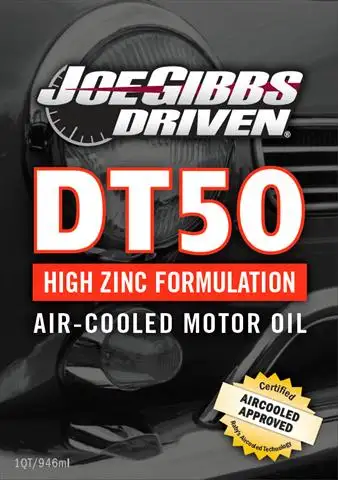
Although LN Engineering is primarily known for aftermarket Porsche parts, many recognize our contribution to the automotive aftermarket for being among those who identified that the reformulation of engine oils to reduce ZDDP content back in the early 2000s was contributing to the rash of flat tappet camshaft and lifter failures. This led to our working with Driven Racing Oils, then Joe Gibbs Racing Oils, and working closely with Lake Speed Jr. during his time at Joe Gibbs and later Driven to develop and test their DT40, BR40, and DI40 oils and Raby’s Aircooled Technology with the DT50 oils, which was originally developed for use in aircooled VW and Porsche engines.As you can see, the original JGR DT50 (shown right) featured the “Aircooled Approved – Certified by Raby’s Aircooled Technology”.
Even though our focus is on Porsche vehicles, we have taken great care to research and provide information that is invaluable to all owners of classic cars and those with performance engines. Our decades of research and development with thousands of hours on the dyno and hundreds, if not thousands, of used oil analysis tests back up our recommendations. To this day, we still work closely with Lake Speed Jr. at SPEEDiagnostix, now better known as the “Motor Oil Geek“, and Bill Alexander at Driven Racing Oils, so we’re connecting with those in the know. We invite you to read this article and watch our videos, then find out for yourself what we’ve learned.
Remember, shopping for oil by brand, previous reputation, or by manufacturer approvals alone does not guarantee the best oil for your classic car or performance engine.
Original Joe Gibbs Racing Driven DT50 15W-50, developed for aircooled Porsche and Volkswagen engines and carrying Raby’s Aircooled Technology certification.
Quick Porsche Motor Oil Recommendations
If you are looking for a quick starting point, the recommendations below summarize the oils LN Engineering commonly uses for Porsche street, track, and engine break-in applications. These recommendations are intended for vehicles outside any manufacturer warranty requirement. Always consider the specific engine, ambient temperature, oil temperature, bearing clearances, emissions equipment, and how the vehicle is used.
| Application | LN Engineering Recommendation | Why |
|---|---|---|
| Aircooled Porsche – street use | Driven DT50 15W-50 | High-temperature film strength and an additive package developed for classic aircooled engines. |
| Watercooled Porsche – A40-type applications | Driven DT40 5W-40 | Shear-stable 5W-40 street oil with robust anti-wear and friction-modifier chemistry. |
| Direct-injected Porsche – C40-type applications | Driven DI40 5W-40 | Designed for direct-injected engines where fuel dilution, LSPI protection, and deposit control are important. |
| Direct-injected Porsche – C30 / C20-type applications | Driven DI30 / DI20, where the viscosity is appropriate for the application | Maintains the direct-injection-focused formulation while matching the lower viscosity required by the engine. |
| Watercooled Porsche – track use | Driven XP9 | Competition formulation for sustained high load and high oil temperature. |
| Aircooled Porsche – track use | Driven XP6 | Higher-viscosity competition oil for sustained high-temperature use. |
| New or freshly rebuilt engine | Driven BR Break-In Oil | Break-in chemistry intended to promote proper ring seating and valvetrain protection. |
If your Porsche is still under warranty, use an oil carrying the Porsche approval and viscosity specified for your vehicle. Outside of warranty, LN Engineering’s recommendations place greater emphasis on the engine’s actual operating conditions, wear protection, oil temperature, and service interval.
The purpose of proper lubrication is to provide a physical barrier (oil film) that separates moving parts reducing wear and friction. Against popular belief, metal to metal contact does occur and these surfaces are highly dependent on a strong and robust anti-wear film. Oil also supplies cooling to critical engine components, such as bearings. The viscosity of the motor oil throughout the operating range of the engine is very important to the “hydro-dynamic bearing” layer of oil film that forms on and between moving engine parts. Where metal to metal contact occurs, boundary lubrication occurs when insufficient film to prevent surface contact and where the primary anti-wear additive ZDDP plays its role in protecting your engine. Detergent oils contain dispersants, friction modifiers, anti-foam, anti-corrosion, and anti-wear additives, all of which can affect the strength and durability of anti-wear films. Not sure what you need to know about oil? You don’t need to be a tribologist. Just remember the 4 R’s when choosing the best oil for your engine: the right oil in the right place at the right time and in the right amount.
Not all motor oils are created equally when it comes to the levels of additives and detergents used. These detergents carry away contaminants such as wear particulates and neutralize acids that are formed by combustion byproducts and the natural breakdown of oil, but can also inhibit the formation of ZDDP anti-wear films on critical engine components. In an SAE whitepaper on the development of the API SL standard, Shell’s own lubrication engineers stated that‘the introduction of ash-less and zinc free oils are on the horizon making choosing an oil that much more difficult for older engines.’ The focus of this study is on the levels of zinc and phosphorus found in motor oils, more exactly, the zinc (Zn) and phosphorus (P) that makes up the anti-wear additive ZDDP, zinc dialkyl dithiosphosphate. Oils for modern engines have different formulation constraints than those for older engines and just because oils are “modern” or synthetic does not mean they will provide adequate protection for your engine. Shopping for oil by brand, previous reputation, or by manufacturer approvals alone does not guarantee the best oil for your classic car or performance engine.
This does not mean modern motor oils are bad. Quite the opposite: modern oils are remarkably capable when used in the engines and applications they were designed around. Late-model engines may depend on specific oil viscosities and chemistries for turbocharger protection, variable valve timing, timing chain durability, low-speed pre-ignition protection, emissions-system compatibility, piston cleanliness, and fuel economy. For a stock, late-model vehicle—especially one still under warranty—the manufacturer-required viscosity and specification should always be the starting point.
The distinction is that the needs of an older, modified, air-cooled, flat-tappet, or competition engine may be different. An oil can meet the newest passenger-car specification and still not be the best choice for an engine operating with different bearing clearances, valvetrain loads, oil temperatures, or sustained high-rpm use. Oil selection should be based on the engine, how it is built, its condition, and how it is actually used—not simply on whether an oil carries the newest specification.
The current API SQ and ILSAC GF-7 standards were introduced for modern gasoline engines with increased requirements for protection against low-speed pre-ignition, timing chain wear, high-temperature deposits, sludge and varnish, while also addressing fuel economy, emissions-system compatibility, and modern low-viscosity applications. API considers its current gasoline service categories backwards compatible with earlier API categories. However, meeting the requirements of an older API category is not the same thing as being optimally formulated for every older, classic, modified, or competition engine. Engines with different valvetrain designs, bearing clearances, operating temperatures, emissions equipment, or duty cycles may have lubrication requirements that fall outside the priorities of current passenger-car oil specifications.
Even prior to the introduction of the SM, SN, SP, and current SQ API standards, there was concern that changes made to passenger-car motor oils could affect their suitability for older engines. This was specifically discussed in relation to changes in ZDDP, which has long served as both an anti-wear and antioxidant additive. SAE 2003-01-1957, Effect of Oil Drain Interval on Crankcase Lubricant Quality, Shell Global Solutions, discussed how lubricant performance requirements were changing while formulations also had to account for environmental and emissions-system considerations. The important takeaway is not that newer oils are inherently inferior, but that an oil optimized for a modern emissions-equipped engine and long drain interval may not be optimized for an older, modified, aircooled, flat-tappet, or competition engine. Choose the lubricant for the engine and application rather than assuming that the newest specification is automatically the best fit.
What general characteristics make motor oils specifically well suited to a particular engine? Aside from recommendations issued by the manufacturer, what makes for a good motor oil? These oils must be thermally stable, having a very high flashpoint, low NOACK volatility, and must “maintain proper lubrication and protect vital engine components under the extreme pressure and the high temperature conditions.”
For example, for aircooled Porsche engines, 15W-40 viscosities are recommended below 80F ambient air temperatures and 20W-50 should be used in hotter climates above 80F. Porsche recommends and uses Mobil 1 0W-40 as a factory fill in new vehicles and Mobil 1 15W-50 has been a popular choice used by many year-round in aircooled Porsche models, but most Porsche specialists agree there are better choices available. What was once considered a ‘safe’ oil is no longer, as many of these lubricants have been reformulated for many reasons. This includes for protection of emission control devices, increased fuel economy, and longer oil change intervals. As mentioned previously, shopping by brand alone or following manufacturer recommendations does not by itself ensure the best performance for every older, modified, or competition engine.
Tribology—the study of friction, wear, and lubrication—is central to choosing the correct engine oil for Porsche, classic-car, and high-performance applications.
Using a factory approved or recommended oil also doesn’t necessarily guarantee the best results, however if your vehicle is under warranty, it is always advisable to use an oil carrying manufacturer approval to protect your warranty. Simply cutting the factory recommended interval in half both for time and mileage will provide significant improvement when using factory approved oils. Outside of warranty requirements, the available options for lubricants become much greater. According to Lake Speed Jr., a certified tribologist and one of the founders of Driven Racing Oils, when choosing a lubricant, you need to remember the 4 R’s: the right oil, in the right place, in the right quantity, and at the right time.
It is worth noting that Mobil offers its own line of racing oils for track use and Porsche even now offers its own line of classic oils for protecting older aircooled engines and even specialty oils for watercooled 986 and 996 models, so oil selection is more important now than ever. Understanding what changes have been made, and why, is important in selecting the right lubricant. Porsche’s recommendation in hand, our initial analysis from 2005 and 2006 and from virgin oil analyses going back to the 1990s, we found that then prior SH/SJ formulations of Mobil lubricants tested, including Mobil 1, have had higher Zn and P content than what is found in current API oils. Even those products intended for classic car and performance engines that have “re-introduced” have been reformulated and are not the same was what was previously available. Aside from reduced Zn and P levels, many products with adequate levels of Zn and P still use very high levels of detergents. It is well documented in various SAE publications that high levels of Calcium detergent cause more wear than Ca/Mg or Ca/Mg/Na detergent blends that were commonly used back when the API SH/SJ standard was current. However the companies who make the oil additives have discontinued these older additive packages, requiring reformulation with additive packages designed for modern engines. Along with changes to detergents and detergency, the industry-wide reduction of ZDDP in many passenger-car formulations means that some modern oils may not be the best match for classic-car and performance engines that were designed around different viscosities, additive levels, valvetrain loads, and service intervals.
As already mentioned, passenger-car motor oil formulations have changed substantially over the past several decades, including changes to zinc, phosphorus, detergents, dispersants, friction modifiers, and base oils. Depending on the detergent system and the intended application, classic and performance oils may use higher levels of ZDDP than current resource-conserving passenger-car formulations. API SQ and ILSAC GF-7 became the current gasoline-engine standards in 2025, adding requirements for fresh- and aged-oil low-speed pre-ignition protection, timing-chain wear, high-temperature piston and turbocharger deposits, sludge and varnish control, fuel economy, emissions-system compatibility, and ethanol-fuel operation. API considers current gasoline service categories backwards compatible with earlier API categories, but backwards compatibility means the oil satisfies the applicable minimum category requirements; it does not mean every API SQ/GF-7 oil is optimally formulated for every older, classic, modified, aircooled, or competition engine. For those applications, viscosity, HTHS, volatility, anti-wear chemistry, detergency, operating temperature, valvetrain design, and service interval still need to be considered.
It is worth noting that prior to this movement to reduce Zn and P levels, the oils recommended for use in an aircooled Porsche engine back in the 1990s typically had 0.14% Zn and 0.14% P content with less detergency, than found in later API SL-SM street car formulations. In comparison, an API SE-rated virgin oil sample of Kendal GT-1 motor oil from the 70’s, pre-dating today’s limited Zn and P mandates, contained 0.14% Zn and 0.12% P, again with significantly reduced detergency. These oils were run with relatively short drain intervals compared to those now recommended by most automobile manufacturers. Oils with later API SH and SJ standards with no limit for phosphorus were developed, tested, and used in aircooled engines through the end of production of the Porsche 911 993 model with aircooled Mezger engine. With this knowledge, it can be concluded that any given motor oil should have a minimum of 0.14% zinc and 0.12% phosphorus for aircooled engines, given an average 0.25% total detergent levels (which is the average detergency for API SJ rated oils). The lower the detergency, the less ZDDP is needed. Remember, it is all about additive balance!
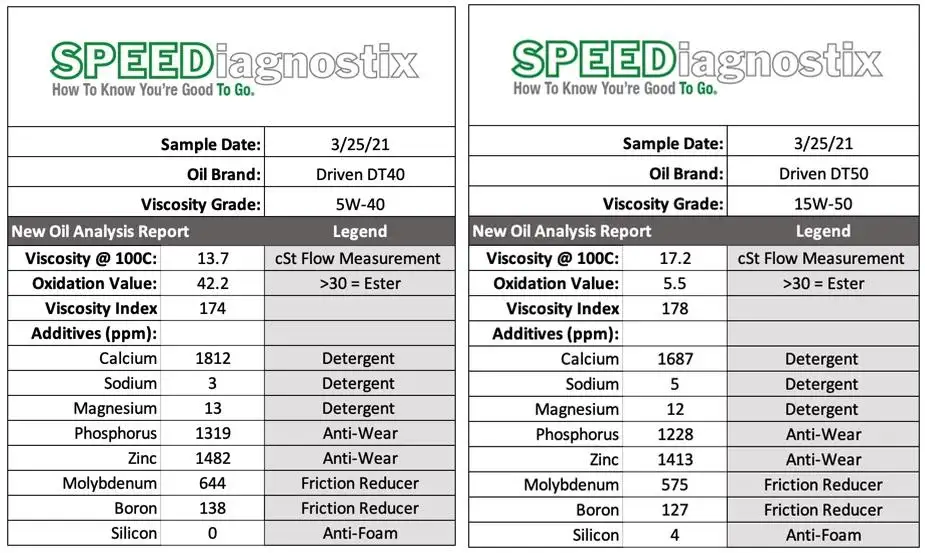
Oil companies have been switching to alternative zinc-free (ZF) additives and ash-less dispersants in their new low SAPS oils since higher levels of Zn, P, and sulfated ash can reduce the life expectancy or performance of emissions control devices. To offset the reduction of zinc and phosphorus levels required by the EPA and manufacturers, boron as well as molybdenum disulfide, among other friction modifiers, has been added to modern oils, since they do not foul the catalysts in the particulate emissions filters or catalytic converters. It is worth noting that most Porsches have lived the majority of their lives with high Zn and P oils as found in API SG-SJ oils, as late as 2004, and these vehicles never have suffer damage to the catalytic converters caused by high levels of ZDDP. The addition of boron, when in the presence of ZDDP, does boost the anti-wear properties. Although considered a friction modifier, moly does have benefits beyond increasing fuel economy to meet CAFE (Corporate Average Fuel Economy) fuel requirements enacted by Congress in 1975. Moly is an antioxidant and provides additional LSPI protection for modern gasoline direct injected engines. The inclusion of moly and boron alone do not completely address wear issues of classic car and performance engines that require higher levels of Zn and P. Cutting edge research being conducted at ORNL and by other researchers in the area of ionic liquids may possibly bridge the gap between fuel economy and wear requirements and provide true backwards compatibility for engine oils.
In addition to protecting emissions controls, there are many other design considerations in formulating engine lubricants, which include improving fuel economy and longer drain intervals. Many believe that the EPA has banned zinc and phosphorus in motor oils. This is not true. In response to modern engine design and longer emission control warranties which are required by the EPA, manufacturers have turned to reformulation of oils to do this, as well as to improve fuel economy by reducing friction. High friction can result in areas with boundary lubrication or where high viscous frictional forces and drag may occur with hydrodynamic lubrication in bearings. The use of friction modifiers, such as moly (there are many different species of Mo-based friction modifiers, help reduce friction in metal-to-metal contact with the formation of tribofilms characterized with their glassy, slippery surfaces. Lower viscosity motor oils are key to increasing fuel economy by their reduction in drag where high viscous friction occurs in hydrodynamic lubrication. While lower viscosities improve fuel economy greatly, they also reduce the hydrodynamic film strength and high-temperature high-shear viscosity of the motor oil, factors both of which are key to protecting high performance engines, especially aircooled ones. It is worth mentioning that bearing clearances in modern engines may require thinner oils, making the formulation and levels of anti-wear and friction-modifier additives even more important to reduce engine wear.
Racing, severe-duty, and specialty oils are often formulated around a different set of priorities than API Resource Conserving passenger-car oils. For a classic, flat-tappet, aircooled, modified, or competition engine, do not assume that an API SM, SN, SP, SQ, or current ILSAC oil is automatically the best choice simply because the specification is newer or technically backwards compatible. Evaluate the complete formulation, viscosity, HTHS, volatility, additive chemistry, shear stability, and intended duty cycle. Likewise, very wide multigrade viscosity spreads can require greater use of viscosity modifiers, so the actual shear stability of a 10W-40, 5W-50, 10W-60, or similar oil matters more than the grade alone. Used oil analysis is the best way to verify whether the oil remains in grade in your particular application.
European ACEA A3/B4 is a High-SAPS, stable, stay-in-grade oil category for gasoline and light-duty diesel engines. Among other requirements, A3/B4 oils use a higher HTHS viscosity than the fuel-economy-oriented ACEA categories, making HTHS, shear stability, volatility, oxidation control, deposit control, and wear performance important considerations when comparing oils. However, ACEA A3/B4 by itself should not be used to infer a specific zinc or phosphorus concentration; the complete oil formulation and any applicable manufacturer approval still matter. Porsche A40 is an OEM approval with Porsche-specific performance requirements and has historically been associated with many watercooled Porsche applications that use higher-HTHS 0W-40 and 5W-40 oils. Newer direct-injected Porsche engines use specifications including C20, C30, and C40, depending on application. Where warranty or factory approval is required, use the Porsche specification called for by the vehicle. Outside of warranty, LN Engineering may recommend a lubricant selected around the engine’s actual operating conditions, oil temperature, fuel dilution, wear trends, and known failure modes rather than approval alone.
Compared to conventional oils, synthetics have superior shear stability leading to improved resistance to thinning and evaporation at high temperatures. Synthetics also have superior cold flow characteristics, reducing start-up wear significantly. Although most modern synthetics incorporate seal swelling agents, for those concerned with formation of new leaks or worsening of existing leaks, an acceptable compromise is the use of conventional (group I or II), semi-synthetic, or group III synthetic oils formulated from very highly refined “hydro-cracked” petroleum base oil stock. Group IV PAO and group V ester base stocks are often blended with group III oils and marketed as full synthetic. Regardless of your choice to use conventional, partial, or full synthetic lubricants, the additive chemistry is just as important as what group base stock is used.
Vehicles that are driven spiritedly, used for autocross, or tracked are subjected to increased stresses that consume the oil anti-wear additives in the engine oil. It is also common for oils to shear out of grade as the viscosity modifiers breakdown. This viscosity loss can have a negative effect on engine wear. As a result, vehicles that are driven hard should have their engine oil changed more frequently. Cars that are taken to the track or raced should have their engine oil changed after every event.
Track use is not simply “hard street driving.” During a road-course session, oil temperatures can climb substantially, the engine spends considerably more time at high rpm and wide-open throttle, bearing loads increase, and turbocharged engines introduce even more heat into the lubricant. Sustained cornering and braking can also expose oil-control problems that may never appear during normal street driving.
That does not mean every track car automatically needs a thicker oil. Oil pressure and oil temperature should guide that decision. If temperature is excessive, the correct solution may be improved oil cooling rather than simply increasing viscosity. If oil pressure drops during braking or sustained cornering, the problem may be oil control rather than the oil itself. The correct viscosity is the one that provides the pressure, flow, and film strength the engine requires at the temperatures it actually sees. For any vehicle that regularly sees track use, monitoring oil pressure and temperature should be considered essential.
Likewise, vehicles subjected to very short drives or sustained operation in heavy traffic should indeed be serviced more often. Another factor to consider is fuel dilution, common to carbureted and direct fuel injected engines. Fuel is not a lubricant, so high levels of fuel in your oil will require more frequent oil changes. Lastly, vehicles that are not regularly driven should be stored with clean engine oil and have a fuel stabilizer added to the gas tank.
Coupled with reduced oil viscosities, modern engine oils are designed to maximize fuel economy, extend catalytic converter life, and reduce tailpipe emissions. It is more important now than ever to select the right engine oil for your classic car or performance engine. Regular used oil analysis is the best way to determine ideal drain intervals for your driving habits and ensure the oil you are using is the best for your engine. With this knowledge in hand, using a quality motor oil formulated for your application with proper filtration and reduced drain intervals, is the best thing to do to protect your engine.
Porsche A40, C40, C30 and C20 Oil Specifications Explained
Porsche oil approvals are more than viscosity grades. They identify oils that have passed a manufacturer-defined performance program for particular generations of engines and emissions systems. The correct approval depends on the specific Porsche model, engine, model year, and market, so the owner’s manual or Porsche technical information should remain the starting point when an approved oil is required.
- Porsche A40: commonly associated with many earlier watercooled Porsche gasoline engines using higher-HTHS 0W-40 or 5W-40 oils. For vehicles outside warranty where A40 is the reference point, LN Engineering commonly recommends Driven DT40 5W-40.
- Porsche C40: used on later emissions-equipped and direct-injected Porsche applications requiring a 5W-40-type oil with different emissions-system and formulation priorities. LN Engineering commonly recommends Driven DI40 5W-40 for applicable vehicles outside warranty.
- Porsche C30: a lower-viscosity Porsche specification used on selected later engines. Where appropriate and outside warranty, the Driven DI series provides a direct-injection-focused alternative matched to the required viscosity.
- Porsche C20: used on selected newer engines designed around still lower-viscosity oils. Do not substitute a thicker oil simply because it appears more protective; bearing clearances, oil-pump strategy, cold-start requirements, emissions equipment, oil temperature, and actual wear trends all matter.
For a stock Porsche still under warranty, use the Porsche approval and viscosity specified for the vehicle. For an older Porsche, modified engine, competition car, or vehicle outside warranty, approval is only one part of the decision. LN Engineering also considers HTHS viscosity, shear stability, volatility, oxidation resistance, fuel dilution, anti-wear and friction-modifier chemistry, oil temperature, oil pressure, and used-oil-analysis trends.
Why Oil Oxidation Resistance Matters
Motor oil performance cannot be judged only by SAE viscosity grade or by the zinc, phosphorus, and molybdenum numbers on a virgin oil analysis. An oil also has to resist oxidation as it is exposed to heat, oxygen, combustion byproducts, and extended service. As oxidation progresses, the oil can thicken, acidity can increase, deposits and varnish can form, and the additive package can be consumed.
This is especially important in aircooled engines, turbocharged engines, track cars, and other applications where the lubricant is exposed to sustained high temperatures. Two oils that look similar on a product data sheet can age very differently once they are subjected to real engine operation.
Tests such as Pressure Differential Scanning Calorimetry (PDSC) can be used to compare oxidation resistance, while used oil analysis can show how the lubricant is actually holding up in the engine. Viscosity retention, oxidation, fuel dilution, acid/base reserve, and wear trends should be evaluated together. This is why LN Engineering places so much emphasis on testing and trending rather than judging an oil by a single specification or additive concentration.
Don’t forget to sign up for our Tech Tuesday Newsletters to receive industry updates and also follow us on Facebook!
And if you don’t already subscribe to the LN Engineering YouTube channel, hop on over there for dozens of technical videos with valuable information everyone should know.
Frequently Asked Questions
When in doubt, always refer to the manufacturer specifications and recommendations for lubricants and viscosities to be used.
Should I use a non-detergent oil to break in a new or rebuilt engine?
Just because non-detergent oil is cheap, it doesn’t mean you should use a cheap non-detergent oil to break-in your new or rebuilt engine. In years past a non-detergent oil was recommended for engine break in as lack of detergents would allow the ZDDP to work better. We now have better oils for engine break in than non-detergent oils. Always use a proper break-in oil in a new engine. Under no circumstances should a partial or full synthetic oil or any oil that has friction modifiers (moly) be used for break-in of a new or rebuilt engine.
How should I break in my new or rebuilt engine?
If you have questions on how you should break in an engine and proper break in procedure, please refer to our guides we specifically provide for air-cooled and water-cooled Porsche engines.
Watercooled Porsche Engine Assembly and Break-In Instructions
Aircooled Porsche Engine Assembly and Break-In Instructions
When can I switch to a synthetic oil on my new or rebuilt engine?
For break in we recommend at at most 200-400 miles on a break-in oil like Driven BR (or the Driven’s GP-1 Break-in) or 607-7177 API CI-4 15W-40 engine oil.
Engines with Nikasil cylinders should only run break-in specific oils for the first 20-30 minutes specifically for cam and lifter/rocker break-in; running break-in oils too long can negatively affect ring break in and can lead to streaking, or worse, bore glazing.
This should be followed by the use of an intermediate conventional oil such as the aforementioned 607-7177 oil for the next 3,000 to 5,000 miles, before switching to a semi- or full-synthetic oil, or until you know for sure the piston rings have seated completely. Driven HR oils are no longer suitable for use as an intermediate oil as they have moly friction modifiers.
For Porsche models, once the engine has been completely broken in and the piston rings are fully seated, we recommend Driven DT50 (15W-50) for aircooled engines. For watercooled engines, Driven DT40 (5W-40) is recommended in place of a Porsche A40 approved oil. Porsche engines with direct injection should use Driven DI40 in place of a Porsche C40 approved oil.
Can I use an oil additive to increase the level of Zn and P in my engine oil?
Few subjects in the motor oil world create more debate than pour-in additives. Products may claim to reduce friction, increase oil pressure, quiet engine noise, restore compression, bond permanently to metal surfaces, or even reverse wear. Additives can certainly change the way an oil behaves, but there is no additive that can restore the original geometry of worn bearings, damaged rings, scored cylinders, or other mechanically worn components. Oil can protect an engine and, in some cases, temporarily mask symptoms, but it cannot rebuild one.
It is also important to remember that a finished motor oil is already a carefully balanced chemical formulation. Detergents, dispersants, anti-wear additives, antioxidants, friction modifiers, viscosity modifiers, and other components are designed to work together at specific concentrations. Adding another chemical to the crankcase changes that balance and can create unintended interactions. Rather than trying to improve an unsuitable oil with aftermarket additives, the preferred approach is to select a fully formulated oil that already provides the viscosity and additive chemistry the engine requires.
That said, never use oil additives to boost ZDDP in your engine oil! Just use the right oil. All Driven Racing Oils are fully formulated to protect classic car and performance engines with the correct ratio of ZDDP, friction modifiers, and detergency. No further additives are necessary. Adding a ZDDP booster or moly additive can throw off the balance of the additives in your oil and can actually cause harm to your engine. If your engine oil needs an additive, you are using the wrong oil.
Does higher ZDDP automatically mean better protection?
No. ZDDP, or zinc dialkyldithiophosphate, is an important anti-wear additive that has been used in motor oils for decades. It can be especially important in engines with high valvetrain loads, including many older flat-tappet engines. However, more ZDDP is not automatically better.
Oil formulation is a balance. Excessive amounts of one additive can interfere with other parts of the additive package or create other unwanted effects. Phosphorus can also affect emissions-system durability when oil consumption allows it to reach the exhaust. Rather than choosing an oil simply because it has the highest zinc or phosphorus level, choose a fully formulated oil that is appropriate for the engine and application.
Adding aftermarket ZDDP boosters to a finished oil is generally not recommended because it changes the carefully balanced additive package already present in the oil.
Do I need to add a moly additive to my engine oil?
If you are using the right engine oil for your application, no additives should be required. Those concerned about Porsche Cylinder Bore Scoring should know that using an oil with high levels of moly is important to preventing cylinder bore scoring. Porsche A40 or C40 approved oils do not have sufficient levels, which may require supplementation with a product like Liqui-moly’s MoS2 or Ceratec treatments. However, if using Driven DT40 or DI40 oils in your Porsche, no additive is required as these oils already have high levels of moly friction modifiers to help prevent Porsche cylinder bore scoring. Like with ZDDP additives, if you are using an engine oil that needs additional friction modifiers to reduce wear, you’re probably using the wrong engine oil.
Does higher moly content mean better protection?
Most Porsche A40 and C40 oils have little to no moly in them. That’s why they aren’t the best for protecting your Porsche engine from cylinder bore scoring. However, for a street driven vehicle, there is an optimal level.
At 350 ppm, the additive maximizes its ability to lower the coefficient of friction to about 0.04. It does this by creating a threshold layer of molybdenum disulfide (MoS₂) within the engine’s protective film matrix.
Many daily-driver motor oils use a lower dose (around 75 to 150 ppm) of modern, trinuclear MoDTC. This lower level still reduces friction quite well but takes a bit more activation time. At 350ppm, which is roughly what Driven’s DT and DI oils are formulated with, drastically cuts down the activation time needed for the protective film to form. It also delivers maximum fuel economy benefits without wasting additives. Pushing the molybdenum level past 350 ppm all the way up to 1,000 ppm, which is common in racing oils like Driven XP oils, does not harm the engine or cause extra wear. However, it offers diminishing returns for standard vehicles and can unnecessarily increase sulfated ash, engine deposits, and oil acidity over long change intervals.
When should I carry out used oil analysis?
It is best to choose a motor oil and stick with that oil and have it tested using used oil analysis to determine a baseline for your engine. This ideally would start with testing of the break-in oil and every subsequent oil change. Through repeated sampling and testing at every oil change, used oil analysis gives you trend data to determine the condition of your engine. The initial sample from break-in should have the highest level of wear metals. Wear should decrease as the engine gets more time and mileage on it. If the wear levels start to trend back upwards or return to levels as high as the initial sample, you likely have a problem. In most cases, used oil analysis can identify issues before there are any actual symptoms. Used oil analysis also can be used to determine appropriate oil change intervals based on your driving habits and also to determine if the oil you are using is correct for your application. The key is regular testing – trending is required to identify problems before they become costly to repair or catastrophic.
Not all used oil analysis is equal. Different laboratories use different testing methods and offer different levels of testing, which can significantly affect both the price of the analysis and the amount of useful information it provides. Inductively coupled plasma spectroscopy, commonly referred to as ICP, is widely used to measure wear metals, additive elements, and contaminants, but it primarily detects very small particles. Rotating disc electrode spectroscopy, or RDE, can respond differently to larger wear particles and may provide additional information depending on the application and condition being monitored.
Spectroscopy is only one part of a complete oil analysis program. Depending on the laboratory and test package, additional testing may include viscosity, fuel dilution, oxidation, nitration, total base number, total acid number, particle count, ferrous debris, coolant contamination, and other measurements. A basic analysis may provide sufficient information for a normal street car, while a track car, race engine, expensive engine, or an engine with a known failure mode may justify more comprehensive testing. When comparing laboratories, compare the actual tests being performed rather than price alone.

The only lab we use and recommend is SPEEDiagnostix Used Oil Analysis. Conventional ICP spectroscopy is most sensitive to very small particles and can under-report larger wear debris, while rotating disc electrode (RDE) spectroscopy can respond to a broader particle-size range and may reveal wear information that conventional ICP testing can miss. SPEEDiagnostix also includes separate testing for oil condition and fuel dilution rather than relying only on elemental spectroscopy. It may not be the cheapest analysis, but for Porsche, classic-car, performance, and competition engines we prefer the additional information provided by the test package and reporting. You can also send us your results and we’ll be happy to review them with you.
When do I need to run a race oil in my engine?
Street oils are formulated around street-duty cycles and are not necessarily optimized for sustained competition temperatures, high rpm, and repeated high-load operation. Anytime you do a high performance driving event, even if it’s your first time taking your car on track, we recommend using a true race oil. These oils typically have added anti-wear additives, reduced detergency, and improved anti-foaming additives, coupled with better base stocks that resist thinning at high temperatures. These oils are designed to protect your engine best under the stress of going on track. Remember, most race oils are good only for about 500 miles, so we recommend changing your oil immediately after a track day so you store your race car with clean oil. You should not store any engine with race oil as true race oils do not have the corrosion inhibitor, dispersant, and detergent additives street oils have. For street cars, that becomes a bit more complicated, requiring you to run change to a street oil between events and run the race oil only for track use. Remember, oil is cheap, engines are expensive! Driven XP Racing Oils are available in conventional, partial, and full synthetic in multiple viscosity grades for all applications. With regards to viscosities, in modern watercooled Porsche engines (or any other engines that run a 0W-40 or 5W-40 as the factory fill), you can run Driven XP9 up to 225F sustained or 240F intermittent, and above these temperatures, you are best to run Driven XP6. Don’t forget, race oils are highly friction modified, so if your piston rings aren’t broken in yet, using a race oil is just as bad as using a synthetic oil in a new engine.
Should I use racing oil on the street?
A true racing oil may be formulated for high load, high rpm, high oil temperatures, improved anti-foaming, and increased anti-wear protection. Those characteristics can be ideal for a competition engine. However, many racing oils are intended for short service intervals and may not be formulated around long drain intervals, extended street use, emissions-system protection, or the detergent and dispersant requirements of a daily-driven vehicle. That does not make racing oil better or worse. It simply means it was designed for a different job.
Should I use a thicker engine oil for the track?
Not automatically.
Track use raises oil temperature and places the engine under sustained high load, so a thicker oil may be appropriate in some applications. But viscosity should not be chosen by guesswork.
The better approach is to monitor oil temperature and oil pressure. If oil temperature is excessive, the solution may be improved oil cooling rather than simply using a thicker oil. If oil pressure drops during sustained cornering or braking, the problem may be oil control rather than viscosity, which can be made worse by high oil temperatures.
The correct oil viscosity is the one that maintains the pressure, flow, and film strength the engine requires at the temperatures it actually sees.
For a dedicated or frequently tracked car, oil temperature and oil pressure monitoring should be considered essential.
Now as far as Porsche specific recommendations, for aircooled Porsche engines, in most cases, a 15w-50 or 20w-50 is recommended. Modern 10w-60 oils are designed for newer engines, and while the viscosity might be ok, these oils are not formulated for older engines. For watercooled Porsche engines, the driving factor for the need for higher viscosity oils is high oil temperatures, resulting in the oil thinning out. For oil temperatures that regularly hit above 230-240F, using a 10w-50 or 15w-50 viscosity oil is recommended, especially for M96 and M97 engines. In fact, Flat 6 Innovations has recommended Driven XP6 exclusively forever.
What should I do if I have an older, higher mileage engine and want to use a synthetic motor oil?
Oils formulated from a group I, II, or III base stock (hydro-cracked petroleum product) are less prone to cause leaks or make existing leaks worse. Most semi or full synthetic oils are formulated with seal swelling agents to minimize leaks, so they often won’t cause leaks in older engines, however if you have an existing leak, these oils likely will make those leaks worse. If you have an older engine that has never been run on a full synthetic oil, you might want to continue to use a conventional oil or try a semi-synthetic like Driven GP-1 over a full synthetic if considering changing oils.
What is the difference between a Multigrade Oil versus Monograde or Straight Weight Oil?
Multigrade oils use viscosity modifiers, also known as viscosity index improvers (VII), which are polymers designed to minimize changes in viscosity as temperature fluctuates. These viscosity modifiers contract at lower temperatures, enabling easier engine starting by improving oil flow, and expand at higher temperatures, helping to maintain oil viscosity and ensuring stable oil film strength even under extreme heat. One critical aspect of multigrade oils is their shear stability. As the viscosity modifiers can shear under mechanical stresses—particularly in high-performance or racing engines—it is vital to select oils formulated with shear-stable polymers. These high-quality polymers resist degradation over the oil change interval, preserving the protective film strength needed to minimize wear on engine components. Cold-start protection provided by multigrade oils is crucial, as most engine wear occurs during startup when engine components are inadequately lubricated. Properly formulated multigrade oils significantly reduce wear at startup by quickly flowing to critical engine components, enhancing protection and extending the life of the engine. Selecting a motor oil with appropriate multigrade additives ensures not only protection against temperature extremes but also maintains efficiency and performance across varying operational conditions. As a result, for most applications, a multi-grade oil is a superior choice compared to mono-grade or straight weight oils.
What is HTHS viscosity and why does it matter?
HTHS stands for High Temperature High Shear viscosity.
It is a measure of how an oil behaves under high temperature and high shear conditions, which is especially relevant inside bearings and other highly loaded engine components.
Two oils can both be labeled 5W-40 and still have different HTHS viscosities. That means they may behave differently under sustained high-temperature operation even though they carry the same SAE viscosity grade.
For street-driven modern engines, the manufacturer’s required oil specification should remain the starting point. For older, modified, air-cooled, or competition engines, HTHS viscosity can be an important part of evaluating whether an oil is appropriate for the application.
Why can two oils with the same viscosity grade perform differently?
The SAE viscosity grade only tells part of the story.
Two different 5W-40 oils may have different base oils, additive packages, volatility, HTHS viscosity, shear stability, detergency, anti-wear chemistry, and intended applications.
One may be formulated primarily for modern emissions-equipped street cars and long drain intervals, while another may be designed for higher-temperature or competition use.
That is why choosing oil based only on the viscosity printed on the bottle is not enough. The oil’s intended application, performance specifications, additive chemistry, and operating characteristics also matter.
Not only that, but checking to see how well the oil’s viscosity has held up after it’s been run is just as important. You can’t simply look at an oil’s specification on paper and say just because it has higher values that it will outperform another oil with lower values. The proof is in the pudding, as they say.
Should I be worried about oil consumption?
It is common for Porsche engines with Nikasil cylinders to consume on average one (1) quart per 1000 miles. However this can vary depending on what oil is used and how the car is driven. In some cases, thinner oils or oils with high levels of friction modifiers can cause increased oil consumption. That said, all engines will consume some amount of oil during normal operation, and that amount can differ from engine to engine. If your engine suddenly begins to consume more oil than normal, that is something to be concerned about. Leaks are often the main cause for oil loss, however if you have no visible oil leaks, it can be assumed that you are burning the oil. The engine oil should be changed and filter cut open to be inspected for debris. Used oil analysis may help to determine if the increased oil consumption is a result of worn components or some external factor such as fuel dilution. A compression test can help to identify the cylinder or cylinders that may be to blame just as a leakdown test can determine if the guides or piston rings are worn, both of which can cause increased oil consumption. It is worth noting that Porsche allows up to 1.6 quarts (1.5 liters) per 625 miles (1000 km) on their modern watercooled engines per Porsche ATI Advanced Technical Information directives.
Should I use a non, partial –synthetic, or full-synthetic motor oil, or perhaps a motorcycle or diesel oil?
An oil’s chemistry is more important than whether it is a conventional, partial, or full-synthetic, but all things equal, if you are using a properly formulated engine oil for your application, using a synthetic will provide the best protection. At the end of the day, the additional cost is a small expense to pay for the added protection.
Many years ago, diesel oils were an acceptable alternative to street car oils. Unfortunately, this ended with any diesel oils with the introduction of the API CJ-4 standard. Modern diesel engines have diesel particulate filters, requiring the engine oils to be reformulated to protect these emissions control devices. Motorcycle oils once considered suitable alternatives to street car oils because of their exceptional shear stability, oxidation and acid control, and high-temperature protection, have been reformulated, making them unsuitable for classic car and performance engines, including aircooled Porsche models. If you want to continue to use a diesel oil, we package a bulk obsolete spec CI-4 diesel 15W-40 engine oil made by ARG that is suitable for engine break-in and beyond, if a conventional non-friction modified oil is desired for use in gas or diesel engines.
What viscosity motor oil should I use?
You should always refer to your owner’s manual for the recommended grade and viscosity of oil to be used in any engine. Typically bearing clearances will dictate the appropriate engine oil viscosity, so it is important to talk to your engine builder for their recommendation when selecting an oil for your rebuilt engine.
For most aircooled Porsche owners, a 15W-50 or 20W-50 can be used year round. For modern watercooled Porsche models, a 5W-40 can be used year round over the factory recommended fill of Mobil 1 0W-40. For Porsche models driven in colder climates, remember that below 15F (-10C), even on an aircooled Porsche engine, you probably should not be running a 20W-50 or15W-50. You should run a 5W-40, which is good down to -13F (-25C) for cold starts. For comparison, a 0W-40 is good down to -40F (-40C). If you plan on starting your watercooled Porsche engine at temperatures below -13F (-25C), you should consider running a 0W-40 instead of a 5W-40 on models where an A40 oil is recommended.
What engine oil or oil additives are best for Porsche cylinder bore scoring?
An engine oil formulated with high levels of moly will help extend the life of your Porsche engine. The inclusion of moly in the engine oil reduces Alusil and Lokasil cylinder wear. Unlike ZDDP that cannot bind to aluminum, moly can. Since the cylinder bores in engines with Alusil or Lokasil blocks are uncoated raw aluminum, moly is the only additive that can bind to the aluminum and exposed silicon particles and reduce cylinder bore wear. Coupled with increased oil viscosity of a 5W-40 or 5W-50 over a 0W-40 oil, moly reduces friction while the increased film strength provides more cushion between the pistons, rings, and cylinders.
Driven’s DT40 and DI40 oils are all formulated with a min of 300 ppm of moly for added Porsche cylinder bore scoring protection, so no additional oil additives are required.
If you are using a Porsche A40 approved oil, most have little to no moly, so using an oil additive like Liqui-moly Ceratec or Swepco oil improver will boost moly levels. However we still recommend using a fully formulated oil rather than relying on oil additives to boost wear protection.
What engine oil is best for my Porsche IMS bearing?
Whether or not you have replaced the Porsche IMS bearing in your Boxster or 911 996 engine, it is important to use the best oil possible in your Porsche engine. The aforementioned Driven DT40 oil has higher ZDDP anti-wear additives and high levels of moly friction modifiers, both which benefit the intermediate shaft bearing. Also using a 5W-40 over a 0W-40 engine oil viscosity will provide a higher HTHS viscosity, which in essence is a measure of the film strength. The problem with the factory recommended A40 oil is that it starts off thin and shears out of grade very quickly, resulting in a viscosity that is below the minimum recommended for lubricating a ball or roller bearing. A40 oils will have lower anti-wear and friction modifier levels, making these oils a poor choice for protecting and extending the life of the Porsche IMS bearing.
What makes modern motor oils not the best choice for aircooled Porsche, classic car, or performance engines?
Modern motor oil formulations are governed by automobile manufacturer requirements and corresponding API or ACEA standards (among other standard bodies). For example, Porsche now recommends 10,000 mi or one year oil change intervals on their newest water-cooled engines. But at one point, Porsche recommended as high as 2 years or 24,000 miles with other European manufacturers recommending even longer oil change intervals. These long oil change intervals resulted in damaged or failed engines due to sludge formation. Increased detergent and dispersant levels were required to maintain engine cleanliness during extended oil change service intervals. As mentioned before, increased detergency requires higher levels of ZDDP to provide critical wear protection – something modern oils do not have.
Another consideration is that modern engine oils are designed to protect emissions control devices, which requires a reduction or elimination of ZDDP anti-wear additives.
Fuel economy and emissions requirements continue to influence the development of lower-viscosity engine oils. Reducing viscous drag can improve fuel economy, which is one reason modern engines are increasingly designed around lower-viscosity lubricants. That does not make a thin oil inherently bad or a thick oil inherently better: the correct viscosity is the one that provides the oil pressure, flow, HTHS viscosity, and film strength required by the engine at its actual operating temperature. Older engines, competition engines, and engines built with different clearances or duty cycles may require a different viscosity strategy than a modern engine designed specifically around very low-viscosity oil.
Modern passenger-car oils are extremely capable for the engines they were designed to protect, but their priorities may be different from those of an older, classic, modified, aircooled, flat-tappet, or competition engine. A lubricant can meet the newest API or ILSAC specification and still be a poor match if its viscosity, HTHS, volatility, additive chemistry, or intended service interval differs significantly from what the engine requires. For older engines, choose the oil by application rather than assuming that newer automatically means better.
Should I use an engine oil flush in my engine?
If you have an engine that is dirty or has sludge buildup, never use an oil flush product. We have seen many engine failures following the use of an engine flush product. Additives to clear up noisy or stuck lifters or engine flush products will dislodge deposits and plug oil passages, among other things.
The best way to clean a dirty engine is to pull the sump if possible to clean sludge or any other contaminants. The oil will need to be changed repeatedly, with no more than 500 miles between oil and filter changes, until the engine oil remains visibly clean after 500 miles. Using this procedure will slowly clean the engine. We would recommend fitting a FilterMag oil filter magnet and magnetic drain plug as well to the engine, if not already fitted. A fuel additive with PEA (poly-ether-amine) should be used at every fill up until the engine and fuel system cleanliness have been restored. However, if the engine is beyond the point of no return with heavy sludge formation or if there is any wear debris indicative of mechanical damage, an engine rebuild is your only recourse for corrective action.
How often should I change my oil?
For most street driven Porsche models, we recommend an oil change interval of 6 months or 5,000 miles.
Older aircooled models like the Porsche 356 should be limited to 3 months or 3,000 miles due to reduced oil system volume. Same goes for older aircooled VW models with the Type 1 and Type 4 engine.
Dedicated track cars should have their oil changed after every event and should be run with a race oil for maximum protection. Race cars should not be stored with a race oil as these oils typically are not formulated with detergents, dispersants, and corrosion inhibitors found in street oils. Mixed street/track use cars should run race oil at the track and have that oil changed out immediately after to a street oil. This may seem extreme, but oil is cheap and engines are expensive!
For classic car or performance engines, changing your oil every 3 months or 3,000 miles or cutting the manufacturer’s recommended oil change interval in half is a good starting point. Otherwise, used oil analysis is recommended to determine the correct oil change interval for your application.
Can a low-mileage or infrequently driven car go longer between oil changes?
A vehicle that is driven very little can still accumulate fuel, moisture, and combustion byproducts in the oil, especially if many of its trips are short and the engine does not remain at operating temperature long enough to remove them. This is particularly relevant to collector cars and weekend vehicles that may accumulate only a few thousand miles per year. Oil-change intervals should therefore consider both mileage and time.
Can I use a thicker oil in my engine?
With requirements for increasing CAFE, or corporate average fuel economy, in mind, manufacturers have continually pushed for thinner and thinner engine oils to help reduce fuel consumption. In some instances, there is a tradeoff of higher wear in those engines. However, manufacturers often make allowances for thicker oils for extreme or severe duty environments. First, check your owners’ manual to verify what the manufacturer recommends.
A good example of a manufacturer making a change is GM with the L87 engine, making a fleetwide change to a 0W-40 from a thinner 0w20 oil to address issues with these engines.
If you do choose to run a thicker oil, for example a Porsche C40 or C30 in place of a C20, expect a drop in fuel mileage. It is also highly recommended that you only make this change once you have done used oil analysis and have trend data for your engine so you can actually verify that a thicker oil is actually reducing wear.
Another consideration is cold starts – thicker oil flows slower, so you may find that in summer months you can run a thicker oil, but in the winter, it may make sense to go back to a thinner oil.
Lastly, when choosing to run a thicker oil, be mindful that a thicker oil may flow slower through the oil filter. Where possible, fit a larger oil filter to increase surface area within the filter. If you are running a synthetic media filter like the Wix XP or Mobil 1 oil filter, these filters are slightly more restrictive, so keep that in mind when using them with thicker engine oils.
When should I change my oil if I put my car into storage for the winter?
Vehicles stored for winter should have their oil changed prior to being put into storage. Driven Storage Defender, Carb Defender, or Injector Defender should be used to stabilize the fuel and protect the fuel system. It is important to add the additive before filling the gas tank and to run the vehicle to ensure the fuel with additive has made it completely through fuel system. After the car has been put into storage, do not start up and let your engine idle. It is best to let it sit dormant until you take the car out of storage and have the opportunity to drive the car for an extended period and get the oil to full operating temperature, ideally 220F to vapor off any moisture in the engine.
Adding a battery tender to maintain your battery and also inflating your tires to the maximum permissible pressure stated on the sidewall are added precautions you can take to make sure your car is ready in the spring when you want to pull it out of hibernation. Just don’t forget to correct the tire pressures before driving your car!
What oil filter should I use?
Just like with motor oils, people have their favorite oil filters. We have purchased and cut apart dozens of brands of filters, all leading us to one conclusion – other than using a Genuine Porsche oil filter, the only aftermarket filters we use and recommend are Napa Gold filters. Napa Gold filters are manufactured by Wix who is now owned by Mann+Hummel who is an OEM for Porsche and many other German auto manufacturers.
We do not recommend using the Napa Select or Napa Platinum filters, nor any Napa filters that are made in China, as Napa (Altrom) has multiple suppliers for their Napa Gold filters. For now, Napa Gold filters that are made in Mexico or the USA still retain the Mann+Hummel logo and are still recommended by LN Engineering.
Likewise, genuine branded filters manufactured by Mann+Hummel in the USA and or Mexico are also suitable in place of Napa Gold filters. For example, the Napa Gold 1042 would be replaced by the Wix 51042 and the Napa Gold 1348 would be replaced by the Wix 51348. We have inspected the Wix filters and they are exactly the same as the old Napa Gold filters (not the ones now made in China).
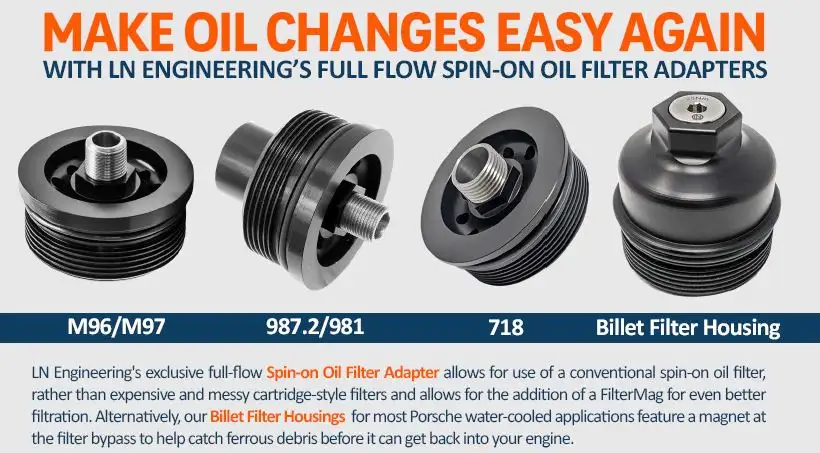
Do I need to pre-fill my oil filter with oil before installing it on my engine?
We do not recommend pre-filling the filter with oil before installing it on your engine, especially on Porsche M96 and M97 engines used in 97-08 Boxster, Cayman, and 911 models, however it is important to lubricate the o-ring or gasket on the oil filter to ensure the seal is not damaged during installation. Some will argue that you need to pre-fill the filter, however how would this be done on an engine where the filter is sideways or installed upside down. It obviously is not a problem having a “dry” oil filter on these models, so pre-filling your oil filter is not necessary or required.
Can fuel dilution make my oil too thin?
Yes. Fuel dilution occurs when unburned fuel enters the crankcase and mixes with the engine oil. This can reduce viscosity and weaken the oil film protecting bearings and other components. Remember, fuel is not a lubricant, it’s a solvent.
Fuel dilution can occur from frequent cold starts, short trips, rich operation, direct injection, engine tuning problems, excessive idling, or certain competition operating conditions. This is one reason mileage alone does not always tell the whole story when determining an oil change interval. Used oil analysis can be especially useful for identifying fuel dilution and determining whether it is affecting viscosity. If fuel dilution is excessive, the underlying cause should be corrected rather than simply switching to a thicker oil to compensate.
Often the most common causes for high fuel dilution are dirty injectors which affect fuel atomization. Fuel that doesn’t atomize can’t burn. Vacuum leaks also lead to over-fueling which can wash cylinder bores down, promoting increased wear, which can lead to bore scoring.
Port-injected engines, if not short-tripped and operated at temperature for extended periods, should generally have 1% or less fuel dilution. Direct injected engines can have several percent higher fuel dilution, even in the 2-3% range; this is one reason shorter oil change intervals are that much more important, especially with GDI engines.
What fuel system cleaner, lead additive, or octane booster should I use?
Fuel system cleaners are widely available from dozens of companies, all promising everything from helping you to pass emissions testing to increasing octane. Many do little more than put a drain on your wallet. In most cases, using a quality pump premium formulation is the best thing you can do for your engine, regardless of octane requirements. However, the only fuel additive that has any actual benefit is poly-ether-amine. PEA can be found in products advertised as a complete fuel system cleaner or treatment, such as Driven Injector Defender or Driven Carb Defender.
For fuel systems that have not been serviced properly or for which you do not have a service history, repeated treatment with Driven Injector or Carb Defender will be required to restore proper function. If you continue to have symptoms associated with bad injectors, the only solution will be to send the injector for cleaning or replace with new injectors.
If you have an older engine that does not have hardened valve seats and requires a lead substitute, Redline makes a products called just that, Lead Substitute, that also cleans your fuel system and is safe for injectors and catalytic converters. This product does not, however, provide protection from the damage of ethanol or should be used as a fuel stabilizer.
What fuel should I use in my car?
Most modern engines and fuel management systems can adjust for the increased octane and provide improved fuel economy and horsepower, so even though the octane requirement may be 87 or 91 octane, it can benefit from 93 octane. Most importantly, always use a Top Tier fuel. If an ethanol enriched fuel must be used, Shell’s Top Tier V-Power premium unleaded is the fuel we recommend running, where available. Chevron with Techron is another excellent choice for Top Tier fuel. Where ethanol-free fuels are not available, do not use any fuel with ethanol content higher than 10%, as this will cause damage to fuel systems and engines not designed for higher ethanol content. Case in point, Porsche released a bulletin many years ago stating that Boxster and 996 models are compatible with E10 fuels, however prior models should not be run with ethanol content exceeding 5%, and recommend using the Porsche Classic Fuel Additive for these models. However, for most of the country, that’s simply not feasible, meaning you need to use a fuel additive like Driven Injector Defender or Driven Carb Defender in these older models, or pretty much any car manufactured before model year 2000.
Stay away from 100LL aviation (AV) gas. If you need leaded fuel, use Redline Lead Substitute. Likewise, if you need to boost your octane, use race gas.
Lastly, modern E10 fuels have a very short shelf life. Fuel not used within 4 weeks of being pumped will start going bad, so a fuel stabilizer must be added. Use of Driven Carb Defender, Storage Defender, or any other Driven fuel system product will stabilize these ethanol enriched fuels.
How much gear oil does my Porsche gearbox/transmission/differential take?
The approximate fill quantities are as follows:
- 901 approx. 2.5 L
- 902 approx. 2.5 L
- 905 approx. 2.5 L
- 911 approx. 2.5 L
- 914 approx. 2.5 L
- 915 approx. 3.0 L / 3.1 L *with radiator coil
- 925 approx. 2.5 L
- 930 approx. 3.7 L
- G50 approx. 3.6 L
- G64 approx. 3.8 L
- Front-axle final drive (four-wheel drive) Type 264/00 approx. 1.2 L
- Rear-axle final drive (Tiptronic transmission) approx. 0.9 L
What is the difference between a GL-4 and a GL-5 gear oil and which one should I use?
GL-4 gear oils are typically recommended for synchromesh, spur, spiral bevel, and helical gears used in manual transmissions and transaxles and axles with hypoid gears operating under moderate speeds and loads without shock loading. GL-4 gear oils are considered safe for yellow metals such as brass synchros where GL-5 rated gear oils have a higher concentrated sulfur phosphorous that will attack yellow metals. GL-5 gear oils are typically recommended for hypoid gears in automotive axles operating under high-speed, high-load, and severe service conditions. For comparison, a GL5 gear oil has about twice as much extreme pressure EP additive as a GL4, ensuring the greatest protection, performance, and efficiency for a spiral bevel or hypoid gear system. A GL4 gear oil should not be used in a hypoid gear system as it can not only reduce performance, but also damage the gears. Although the GL-5 service rating technically supersedes the GL-4, that does not necessarily mean that a GL-5 will be satisfactory or appropriate for transmissions and transaxles where the manufacturer originally recommended a GL-4 gear oil. When in doubt, refer to the manufacturer’s most current recommendations.
A GL-5 can be used where a gear oil with the MIL-PRF-2105E specification is recommended, however not all GL-5 gear oils will meet the SAE J2360 specification that requires addition testing to above and beyond the API GL-5 standard. Driven Go 75w-90 LS is suitable for Porsche gearboxes