
When to Replace The Porsche IMS Bearing

When to Replace a Porsche IMS Bearing — and How to Tell If It Has Already Been Replaced
How Do I Know If My Porsche IMS Bearing Has Been Replaced?
If you own a 1997–2005 Porsche Boxster or normally aspirated 911 with a serviceable IMS bearing, two questions matter: has the original bearing already been replaced, and if so, when does the replacement need to be serviced again? Service records, serial-number documentation, the IMS flange, and the specific replacement product can all help answer those questions.
This guide focuses specifically on identifying previous IMS service and determining the correct replacement interval. For a year-by-year breakdown of factory bearing types, see our Porsche IMS Bearing Problem Years guide.
In This Guide
- Which Porsche models have a serviceable IMS bearing?
- How can I tell if the IMS bearing has already been replaced?
- When does a replacement IMS bearing need to be replaced again?
- What if I do not know which IMS bearing was installed?
Which Porsche Models Have a Serviceable IMS Bearing?
The IMS bearing supports the flywheel end of the intermediate shaft in Porsche M96 and M97 engines. External IMS bearing replacement applies to engines fitted with the earlier serviceable dual-row or single-row bearing. In practical terms, that generally means 1997–2005 Boxster models and 1999–2005 normally aspirated 911 models, with important transition-year exceptions.
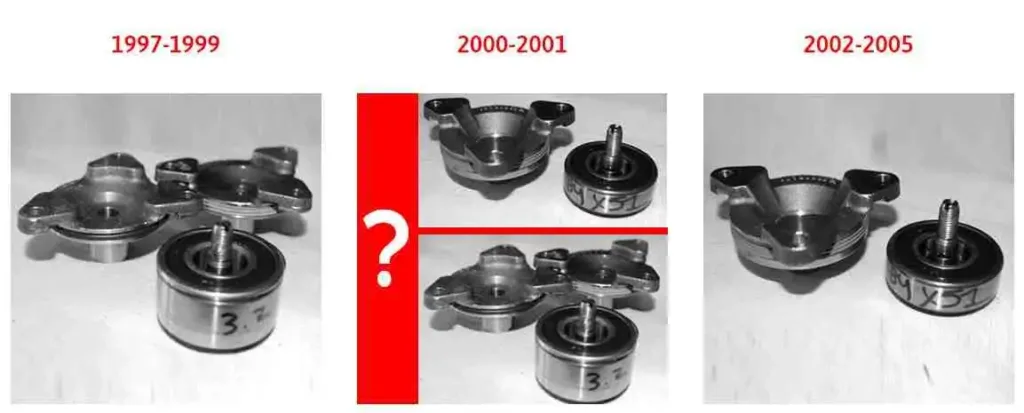
- 1997–1999 Boxster and 1999 911 996: generally fitted with the serviceable dual-row IMS bearing.
- 2000–2001 Boxster and 911 996: may have either a dual-row or single-row IMS bearing. The actual bearing should be verified before ordering parts.
- 2002–2004 Boxster and 911 996: fitted with the smaller serviceable single-row IMS bearing.
- 2005 Boxster 987 and 911 997: transition year. Many have the serviceable single-row bearing, while some later engines use the larger non-serviceable bearing.
- 2006–2008 Boxster 987, Cayman 987, and 911 997: fitted with the larger non-serviceable IMS bearing, which cannot normally be replaced externally.
Because 2005 was a transition year and factory replacement engines may use a different IMS bearing than the vehicle originally received, model year alone should not be used to identify every engine. Learn more about the larger non-serviceable 2006–2008 Porsche IMS bearing.
How Can I Tell If My Porsche IMS Bearing Has Already Been Replaced?
The first and most straightforward way to determine whether your Porsche’s IMS bearing has been replaced is to review the service records. Look for an invoice that identifies the specific IMS product installed, the installation date, and the vehicle mileage at the time of service. A vague entry such as “IMS reseal” should not automatically be interpreted as proof that the bearing itself was replaced.
Many shops historically performed an “IMS reseal,” replacing the IMS flange seal, center nut, or related hardware without replacing the bearing itself. This can create confusion years later. Also keep in mind that there was no commercially available external IMS bearing replacement before the IMS Retrofit was introduced in 2008, so an earlier service entry should be reviewed carefully.
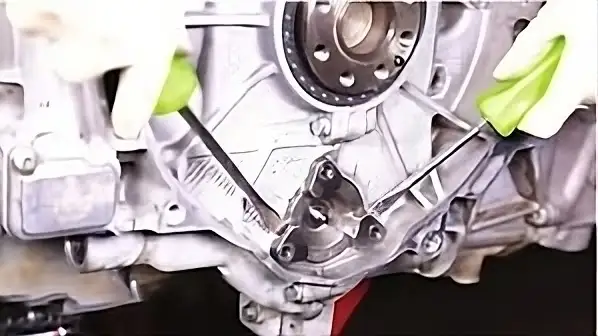
Physical inspection can also help, but access requires removal of the transmission or separation of the engine and transmission. An aftermarket IMS flange or other visible hardware may indicate previous service, but appearance alone does not always identify the exact bearing or establish when it was installed. Documentation and serial-number verification are preferable whenever available.
All IMS Retrofit, IMS Solution, and RND RS Roller IMS kits include serial-number documentation that should be retained with the vehicle. If the installation was registered with LN Engineering, you can search the IMS database to verify a registered IMS Retrofit or IMS Solution installation and, where available, review additional installation information.
Have an LN IMS Serial Number?
Use the IMS Lookup to check registered IMS Retrofit and IMS Solution installations and review available production or installation information.
Porsche IMS Bearing Replacement Service Intervals
Replacement ball and roller IMS bearings are wear components and should be serviced according to the interval specified for the product installed. Time and mileage limits are whichever comes first.
| IMS Bearing / Solution | Recommended Service Interval |
|---|---|
| Single Row Pro IMS Retrofit | 6 years / 75,000 miles |
| Classic Dual Row IMS Retrofit | 6 years / 75,000 miles |
| RND RS Roller IMS Retrofit | 6 years / 75,000 miles |
| Classic Single Row 106-08.2 IMS Retrofit | 4 years / 50,000 miles |
| Pelican Parts PEL-IMS-1 | 3 years / 36,000 miles |
| IMS Solution | No scheduled replacement interval |
The IMS Solution is the exception because it eliminates the rolling-element bearing and converts the IMS to an oil-pressure-fed plain bearing. It is designed for the life of the engine and does not have a scheduled IMS replacement interval.
If significant ferrous debris is found in the oil filter or there is other evidence that an IMS bearing has begun to fail, the vehicle should not continue to be driven simply to reach a scheduled service appointment. The engine should be evaluated by a Porsche specialist before any replacement bearing is installed, because an IMS Retrofit or IMS Solution is intended as preventative service rather than a repair for an engine that has already suffered an IMS failure.
What If I Do Not Know Which IMS Bearing Was Installed?
If the records only say that the IMS was “done,” try to identify the manufacturer, product, installation date, and mileage before assuming the bearing is current. Check invoices, serial-number stickers, registration records, and the IMS flange when accessible. If the replacement is a ball or roller bearing and its service interval cannot be established, it is prudent to treat it as a wear item rather than assume it is a lifetime component.
If you are budgeting for replacement, see our Porsche IMS Bearing Replacement Cost guide. If you are unsure whether the engine is healthy enough for preventative service, review the IMS prequalification procedure.
Current IMS Retrofit owners and customers upgrading from certain competing intermediate shaft bearing replacements may qualify for a mail-in rebate. Check the rebate site for current eligibility and terms.
The key is not simply knowing that the IMS was serviced, but knowing what was installed, when it was installed, and whether that product has a future service interval. Documentation and serial-number verification provide the best evidence. When the history is uncertain, identify the bearing before assuming that no further IMS service is required.
For a broader overview of the IMS problem, bearing designs, failure modes, and available solutions, see The Definitive Guide and FAQ for Porsche IMS Bearings.
Need help identifying a previous IMS installation or determining the correct service interval? Contact LN Engineering for application guidance.