How to Prevent Porsche Bore Scoring

How to Prevent Porsche Bore Scoring
How to Prevent Porsche Bore Scoring
Car engines contain a large number of components made from aluminum. In modern watercooled Porsche engines, this includes the pistons and, in many applications, the cylinder structure itself. Aluminum is lightweight, transfers heat efficiently, and allows compact engine designs, but the cylinder running surface has to be engineered carefully to control wear. For decades, Porsche successfully used durable Nikasil-plated aluminum cylinders, which use a fundamentally different running surface than the aluminum-silicon systems discussed on this page. In many Boxster, Cayman, and 911 engines, Porsche instead used hypereutectic Lokasil and later Alusil cylinder technology, where exposed silicon particles in the aluminum bore surface support the piston and rings. When that surface system, piston-skirt coating, or lubrication relationship breaks down, cylinder bore scoring can result.
In this blog we’re covering:
- What is Porsche Bore Scoring?
- Which models are most affected?
- Are there any other vehicles that can suffer from bore scoring?
- Is there any preventative maintenance needed to help prevent bore scoring?
- What if you already have Porsche bore scoring?
What Is Porsche Bore Scoring?
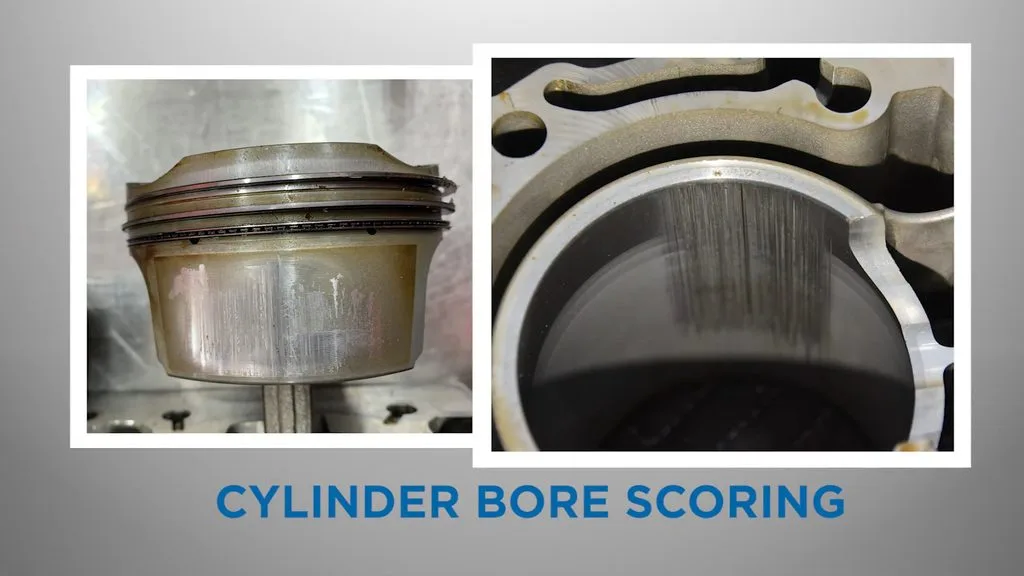
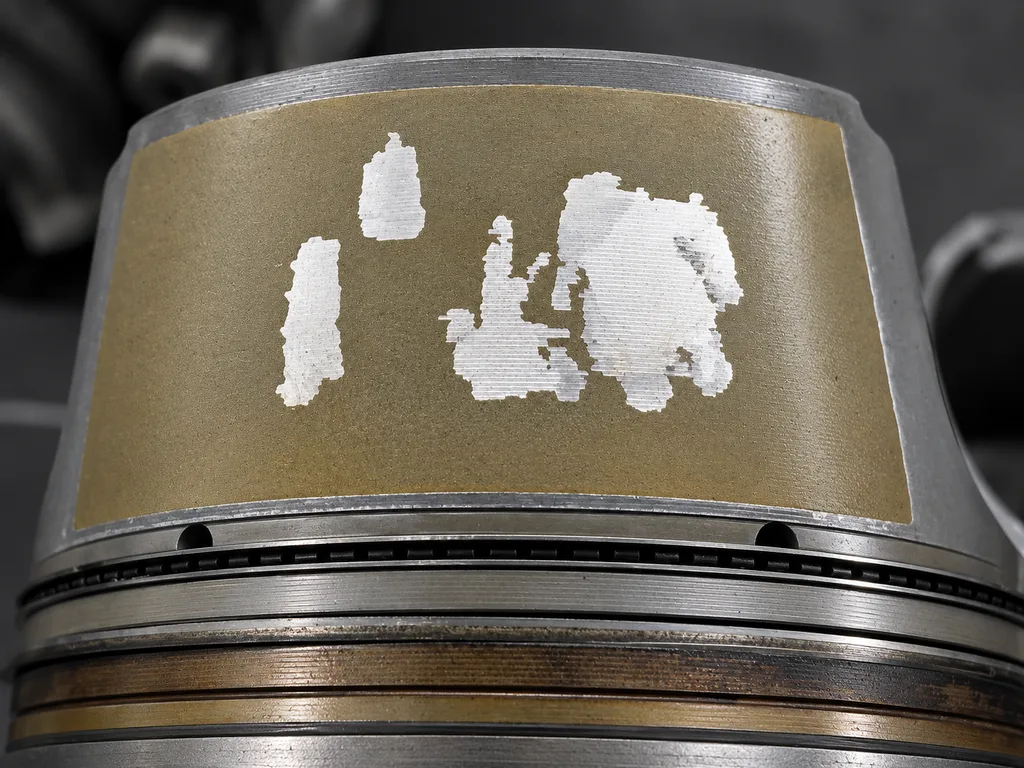
Porsche cylinder bore scoring occurs in engines with Lokasil and Alusil cylinder technology when there is a breakdown of the aluminum-silicon (Al-Si) cylinder system. The exposed silicon particles, compatible piston-skirt coating, piston rings, cylinder surface finish, lubricant, and protective tribofilm all have to work together. When the piston-skirt coating fails, too many exposed silicon particles are damaged, or lubrication can no longer keep the surfaces properly separated, accelerated wear can occur on the pistons, rings, and cylinder walls. Wear debris can then be carried through the bore by the moving piston and rings, further accelerating scuffing and scoring.
Which Models Are Most Affected?
Certain Porsche models are more susceptible than others to Porsche cylinder bore scoring. Porsche 911 996 and 997 cylinder bore scoring is most commonly associated with the 3.6 and 3.8 liter M96.03, M96.05, and M97.01 engines, while Porsche Cayman cylinder bore scoring is commonly seen in the 3.4 liter M97.21 engine. The broader M96/M97 family can experience cylinder-related failures at different rates depending on displacement and piston design; the list below preserves the main model searches owners use when researching this issue. For a detailed model-by-model discussion, see our Porsche Models Without Bore Scoring guide.
- Porsche 996 bore scoring
- Porsche 997 bore scoring
- Porsche 911 bore scoring
- Porsche 987 bore scoring
- Porsche Cayman bore scoring
- Porsche Boxster bore scoring (3.4 M97.22 engine only)
Consider that for an engine that has traveled 60,000 miles, each piston has moved up and down the cylinder hundreds of millions of times. Preventative maintenance cannot guarantee that bore scoring will never occur, but reducing avoidable wear and correcting fueling, lubrication, cooling, or crankcase-vacuum problems can improve the odds of long engine life. As scoring worsens, ring seal can deteriorate, oil consumption can increase, and wear debris and combustion contamination can circulate through the engine oil. In severe cases, continued operation can contribute to damage elsewhere in the engine. For that reason, preventative maintenance and early diagnosis are far less costly than waiting until a scored engine requires rebuilding or replacement.
Are There Any Other Vehicles That Can Suffer from Bore Scoring?

Any engine using a hypereutectic aluminum-silicon cylinder running surface, such as an Alusil-type bore, can potentially suffer from cylinder wear or scoring if the piston, ring, bore-surface, or lubrication system breaks down.
- Porsche Cayenne bore scoring
- Porsche Panamera bore scoring
- Porsche Macan bore scoring
- Mercedes-Benz bore scoring
- BMW bore scoring
- Volkswagen bore scoring
- Audi bore scoring
Engines with aluminum-silicon cylinder running surfaces require a compatible piston-skirt coating to prevent direct aluminum-on-aluminum contact. Depending on the application and era, that skirt surface may be plated or coated. If the coating is compromised, the risk of adhesive wear, galling, and cylinder scoring increases substantially.
These cylinder systems require a chemical or mechanical exposure process that removes a controlled amount of aluminum from the bore surface and leaves the silicon particles exposed to carry the piston and ring loads. When a substantial portion of those exposed silicon particles is damaged or fractured, the surface can no longer function as intended and the protective tribofilm can be compromised, leading to increased wear and scoring. Research commonly cited for Al-Si cylinder systems identifies roughly 40% damaged exposed silicon as a critical threshold.
Although cylinder bore scoring is generally not as commonly associated with these applications as it is with the larger-displacement Porsche M96/M97 engines, the vehicles above have been documented with cylinder wear and scoring. These engines differ considerably in design, so they should not be treated as having identical failure rates or mechanisms. However, many of the same fundamentals—proper lubrication, correct fueling, healthy injectors, controlled operating temperature, and early inspection—can help reduce avoidable wear.
Is There Any Preventative Maintenance Needed to Help Prevent Bore Scoring?
The question we are often asked is: how can you prevent bore scoring from happening to your Porsche Boxster, Cayman, or 911 engine? No maintenance practice can guarantee that an engine will never develop scoring, but the steps below can reduce avoidable wear, identify developing problems earlier, and improve the chances of extending engine life.
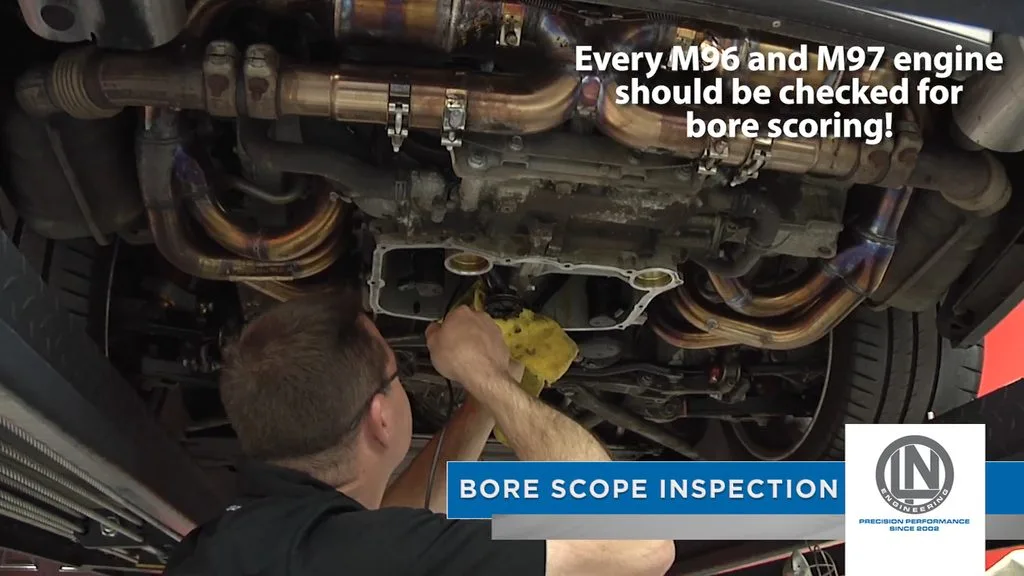
- Borescope your cylinders – It is an excellent idea to establish the condition of the cylinder bores before symptoms become severe. Bore scoping your cylinders for Porsche bore scoring is critical, especially during a pre-purchase inspection. Inspect through the spark-plug opening and, on models where access allows, from the sump so the thrust surfaces can be viewed as directly as possible.
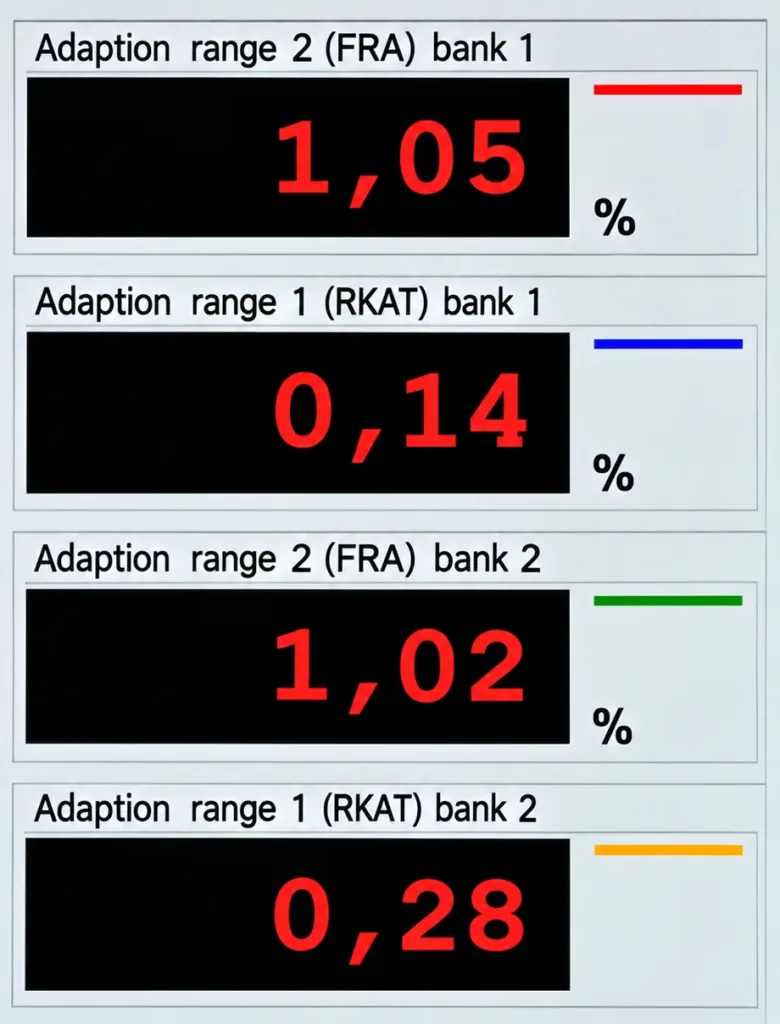
- Check your fuel trims and test for vacuum leaks – A Porsche technician with the proper diagnostic tools should check fuel-trim values and confirm that the engine is operating within specification. A failing mass air flow sensor, oxygen sensor, injector, or other mixture-control problem can contribute to over-fueling and cylinder wash. The oil-fill tube, AOS, and associated vent lines should also be inspected and serviced as required because crankcase and vacuum faults can affect mixture control. Smoke testing the intake and crankcase systems for leaks is highly recommended. The Durametric Porsche Diagnostic Tool can be used to check fuel trims as well as mass-airflow and oxygen-sensor values.
- Perform a manometer test – A healthy M96 or M97 engine should generally show approximately 4.0-6.0 inches of H2O crankcase vacuum. A reading outside the expected range can point toward crankcase leaks, poor ring seal, or an AOS-related problem and should be investigated rather than treated as a diagnosis by itself. The CR Tools Porsche Crankcase AOS Vacuum Measurement Manometer Tool allows you to easily perform a manometer test on your Porsche engine.
- Purchase high-quality gasoline – Choose Top Tier premium fuel, or ethanol-free premium where appropriate and available, to help keep the fuel system and injectors clean. Deposits or poor injector spray patterns can contribute to uneven fueling and cylinder wash, reducing piston and cylinder lubrication.
- Maintain your fuel injectors – Use a bottle of Driven Injector Defender every other fill-up as part of preventative fuel-system maintenance. We recommend replacing fuel injectors at approximately 75,000 miles to reduce the risk of leaking or poorly atomizing injectors washing down the cylinder walls. Having original injectors cleaned rather than replacing them with new units is not our preferred preventative strategy. If an injector is leaking, replacement is the appropriate repair.
- Install a low-temperature thermostat – A low-temperature thermostat begins opening earlier than the factory thermostat and can help reduce localized operating temperatures in M96/M97 engines. The goal is not to run the engine cold, but to reduce temperature extremes and hot spots once the engine is fully warmed.
- Start out slowly until warm – Avoid extended idling to warm the engine. Cold-start enrichment can increase fuel wash while the cylinder walls and oil are still cold. Start driving promptly after startup, keep engine speed below approximately 3,000 rpm, use light-to-moderate load, and avoid wide-open throttle until the engine and oil are fully up to operating temperature.
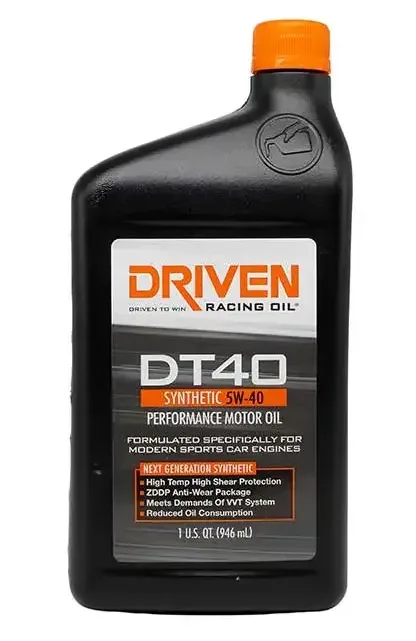
- Change oil at the recommended intervals – It’s important to change your car’s engine oil every 6 months or 5,000 miles using a recommended motor oil appropriate for the engine and intended use, such as Driven DT40 for many A40 applications or Driven DI40 for applicable direct-injected engines. These formulations use an additive package designed for high-performance European engines, including anti-wear chemistry that supports boundary-lubrication protection. If you track your car, drive short distances, or operate the engine in cold climates, more frequent oil changes may be necessary. Short-trip operation is especially hard on oil because fuel, moisture, and combustion byproducts may not be driven off fully.
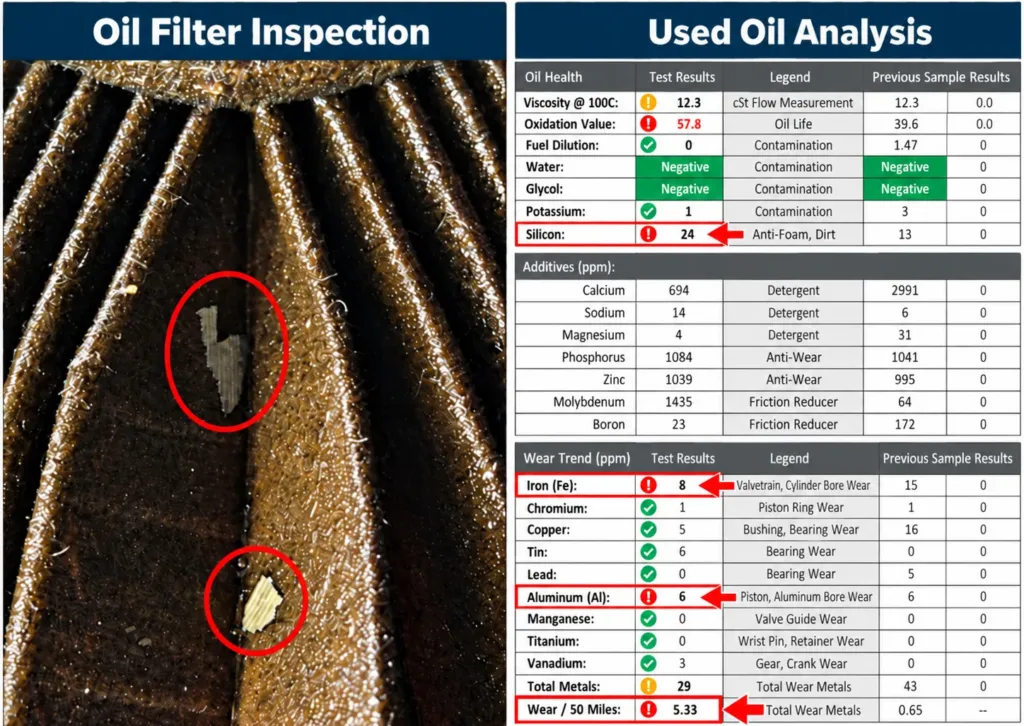
- Don’t neglect your filters – Change the engine oil filter every time you change your Porsche’s oil and inspect the used filter for abnormal debris. Consider LN Engineering’s Spin-on Oil Filter adapter, adding a FilterMag oil filter magnet, and one of our Porsche magnetic engine oil drain plugs. Don’t forget to replace the air and fuel filters at the recommended intervals, using Genuine Porsche, OEM, or LN Engineering-recommended filters.
- SPEEDiagnostix oil analysis – Conduct used oil analysis at regular oil changes to monitor trends in wear metals, fuel dilution, viscosity, and other contamination. Used oil analysis can provide valuable supporting evidence that something is changing inside the engine, but it should not be used by itself to diagnose bore scoring. Conventional elemental analysis does not necessarily detect the larger wear particles associated with cylinder damage, so oil-filter inspection and borescope inspection remain important. Excessive fuel dilution is particularly useful to identify because it may point toward injector, mixture-control, or operating-condition problems that require attention.
What If You Already Have Porsche Bore Scoring?
If you already have Porsche 996 bore scoring, Porsche 997 bore scoring, Porsche 911 bore scoring, Porsche 987 bore scoring, Porsche Boxster bore scoring, or Porsche Cayman bore scoring, then we can help. Same goes for any other vehicles that use Alusil or similar hypereutectic aluminum engine blocks.
Your first step is to correct any lingering issues that may be contributing to cylinder bore scoring, including fueling, vacuum, injector, AOS, lubrication, or operating-condition problems outlined above.
The second step is to consider a higher-viscosity oil appropriate for the engine and operating conditions. For Porsche models already diagnosed with bore scoring, Driven DT50 or Driven DI50 may help reduce piston noise and oil consumption and can sometimes slow the rate at which symptoms progress. This is symptom management, not a repair for damaged cylinder walls. We’ve seen engines with confirmed scoring continue operating for up to roughly 10,000 miles after diagnosis when the contributing issues were corrected and the engine was managed conservatively, but there is no guaranteed remaining service life once scoring is present.
Modern engine-oil development often has to balance wear protection against fuel economy, emissions-system compatibility, cold-start performance, and long drain intervals. That does not mean newer oils are inherently worse, but it does mean the lowest-viscosity factory recommendation is not automatically the best choice for every worn or rebuilt engine. A recent example is General Motors’ move from 0W-20 to 0W-40 as part of its response to problems affecting the 6.2-liter L87 V-8. A viscosity change is still a management strategy rather than a mechanical repair, but it illustrates why oil viscosity has to be matched to the actual condition and use of the engine.
If bore scoring has already been confirmed, see our Porsche Cylinder Bore Scoring Repair Costs guide and the main Porsche Cylinder Bore Scoring Guide for repair options and rebuild planning.
| Image | SKU | Name | Price | Buy: | Stock | hf:tax:product_cat | hf:tax:vehicle-fitment |
|---|